Friday, 15 June 2012
797 years ago today.......
The 15th of June is a big day in history, the United States Constitution was ratified, the Rosenbergs were executed, and Jaws was first released. Okay the last isn't important in the great scheme of things, but for a certain generation it is, because it's an iconic film of its time.
But for the British, or to be more accurate the English it is probably one of the top ten dates in history, and ranks alongside The Battle of Hastings, Agincourt and Bosworth. However, unlike these three examples, it isn't a battle we celebrate, but the signing of a piece of parchment.
On this day in 1215, King John met with a number of barons, and was forced to sign the Magna Carta (or great charter), a document that is one of the most famous in English history. It is important not only as a historical event, but because it compelled the King to concede that his power was not arbitrary, though James I and his son Charles I were believers in the 'divine right of Kings.'
As a document seeking to restrict a monarch's powers, the charter was not unique as Henry I had agreed the Charter of Liberties in 1100 which limited his powers in certain areas. But the Magna Carta is one of the most recognisable names in our island's history.
If you take the time to trawl through it, you'll recognise many things that we take for granted today, but it is also very much a document of its time, as it deals principally with issues relating to the barons, and has political interests such as in clause 50 (clauses were created at a later date):
We will remove completely from their offices the kinsmen of Gerard de Athée, and in future they shall hold no offices in England. The people in question are Engelard de Cigogné', Peter, Guy, and Andrew de Chanceaux, Guy de Cigogné, Geoffrey de Martigny and his brothers, Philip Marc and his brothers, with Geoffrey his nephew, and all their followers.
de Athée being a mercenary who had served John in France, and had cost a thousand marks to free after he had been captured. He had then been rewarded with grants of estates to family members, and many influential and financially beneficial offices.
There are also many clauses relating to marriage and property rights, so it could easily be thought the barons are only concerned about their own. But clauses such as 38 which states, " In future no official shall place a man on trial upon his own unsupported statement, without producing credible witnesses to the truth of it," indicate that an attempt, within the thinking of the time, was made to be inclusive.
Measures were to be standardised for ale, wine and corn, and there were a fair number of clauses to protect free men (a man not tied to a lord or manor) from arbitrary rule. These were all very important and sought to bring order in the life of the kingdom. In fact there also clauses which protected women's rights to property and dowries (if very restricted but then this was the 13th century) but 54 is most indicative of women's place in medieval society, " No one shall be arrested or imprisoned on the appeal of a woman for the death of any person except her husband."
However, certain elements have become especially famous clause 40 stating that, "To no one will we sell, to no one deny or delay right or justice." Number 39 is perhaps the most recognisable to modern sensibilities:
No free man shall be seized or imprisoned, or stripped of his rights or possessions, or outlawed or exiled, or deprived of his standing in any other way, nor will we proceed with force against him, or send others to do so, except by the lawful judgement of his equals or by the law of the land.
Indeed it could be argued that our modern governments might do well to revisit some of these clauses, as in the 'interests of security' authoritarianism is in danger of becoming the mantra.
In effect in can be argued that the Magna Carta is the nearest to a written constitution that this nation of ours has ever got. The protection of property and the protection of freedoms, in the context of the time, was a very radical action, even if its primary purpose was to protect barons from the arbitrary actions of a distrusted and despised King.
The principal clause which deals with this issue is 61, which establishes a committee of 25 barons which could meet at any time in order to over rule King John if he broke the charter, and even seize castles and possessions. It could be argued that the barons were seeking to overthrow the monarch, and although this is possible, the idea of any other system other than monarchy was not on the table. John's son Henry would have been the heir, and as he was only eight in 1215, they would have had the opportunity to mould him to their way of thinking.
But John did not do much to try and dispel this reputation as a despot, as once the barons had left London he repudiated and the pope Innocent III (John had previously been excommunicated by a pope but that's another story) annulled it declaring it a, " "shameful and demeaning agreement, forced upon the King by violence and fear."
Almost inevitably war followed as the First Barons' War followed, which ended in 1217, whereas John had actually died the previous year (dysentery being the most commonly accepted cause). John's son Henry III succeeded him, and he had his own problems with barons in future years.
Magna Carta is considered one of the foundations of English and British constitutional law, and was a real break from the past in many ways. A document protecting certain freedoms and rights, although not unknown, was unusual before the modern period. But Henry I's has established where the monarch could encroach on the rights of nobles, whereas Magna Carta had dealt with the relationships of subjects with each other, and provided legal protections.
I think it is one of the great documents of British history, and that it rightly takes its place amongst those much revered. Reading through it we can see the roots of many of the rights and privileges we enjoy today, and in often take for granted, forgetting just how hard they had to be fought for, and the many that died doing so.
But it was also a document of its time as the barons sought to protect themselves from the King's arbitrary wielding of power, although there are those that argue John has had an unreasonably bad press. But as a young man he rebelled against his father Henry II, and although put in a rather invidious position by his brother's kidnap, his myriad personality faults, and his lack of social skills added up to an unhappy period for the English during his reign.
This was only a short blog, and not a history lesson, so for those interested in learning more In Our Time had a very interesting debate on the Magna Carta, and there are a number of revisionist articles standing up for John, most notably Graham Seel's in February's History Today.
Sunday, 3 June 2012
Writing history; Or how I got the idea to write a biography
A few years ago I thought I'd try and write a history book, but the issue became what to do it on. Perhaps I was approaching it backwards in deciding to write the book, then find the subject, instead of the other way round. However, seeing as our MPs usually wait to see if they get drawn in the private member's ballot before selecting a bill, I am following precedent.
I did my degree, many years ago, in history and politics, so thought the I'd try and combine the two, and with Colchester having such a rich past, I decided that a bit of local history would fit the bill. With my Latin and ancient British languages being non-existent, I decided to eschew the Roman era, and go for something much more recent.
Now for those of us who consider ourselves historians, modern does not mean now, or even within the last fifty years or so, but can include what many consider, a long time ago. When I did my original degree at Essex University, they considered the 'early modern period' to have started in 1485, at the beginning of the Tudor era (which I will still use despite Clifford Davies's protestations) and finally ends around 1750, the beginning of industrialisation in Britain.
Seeing as I was going local, I thought okay, now Colchester actually played a part in what are called the English Civil Wars, or even as 'The Wars of the Three Kingdoms' seeing as Ireland and Scotland became heavily involved.
Colchester's most famous contribution is the siege, which lasted from 12 June-28 August 1648, when a troop of Royalist soldiers managed to barricade themselves inside the town walls, and Parliamentary troops led by Sir Thomas Fairfax blockaded the town. Eventually, after much privation the Royalist troops surrendered, and two of their commanders, Sir Charles Lucas and Sir George Lisle, were summarily executed behind the castle. My picture for this blog was taken next to the monument raised in 1892.
However, the siege has featured prominently in the myriad books about the wars, and for my first effort I wanted to do something I thought might be easier. I therefore decided to start trawling through Colchester's MPs, and the idea of writing short biographies of each appealed. I hadn't seen anything like that around, and thought it would be a good, and concise way of bringing together history and politics.
As I looked through, just drawing together a list, thinking perhaps selecting a number at specific points might be the way to go, I chanced upon the name of Sir Harbottle Grimston. Now this is a name to make anyone stop and look further into, so I did.
The more I delved, the more interesting he became. He was one of Colchester's MPs during the period of the conflicts, but had also ended up spending time in the Tower of London, and was actually the Speaker of the House of Commons which welcomed Charles II to England in 1660. He topped this off with becoming Master of the Rolls before dying in either 1685 or 1683 (depending on what you are reading) in St. Albans, and is buried alongside Sir Francis Bacon.
'So?' I asked myself, if this man did so much, why haven't I heard of him? I don't pretend to be an expert on the period, but you would think with having such an accomplished son, Colchester would have at least one monument of some sort, even if it was restricted to a blue plaque somewhere? But htere is absolutely nothing, bar a portrait in the Town Hall.
The portrait above of Sir Harbottle is by an unknown artist, but probably based upon a portrait by Sir Peter Lely. He is in the robes of the Master of the Rolls according to one source, although the National Portrait Gallery seems to think they are Speaker's.
As I began my researches, one thing I quickly discovered I had to be careful about was which Harbottle I was talking about. Father and son shared the same name, and were both Members of Parliament during the period from 1640 (when Charles I's personal rule ended) until 1647 when the first baronet died.
It was fairly simple to tell the difference in most documents and books where they are mentioned, because the first baronet is the one with the title. This could have been a lot trickier, if young Harbottle had been awarded the knighthood the eldest sons of baronets were normally awarded, but as he was in fact a second son, his elder brother having died, he possibly wasn't actually entitled to it.
These are the sort of questions I knew I would need to try and find answers to as I researched my biography, for by now I was so intrigued by this man, that I decided I might as well follow it through. After all, if there seems to be almost no trace of him in the town where he first appeared on the national scene, I thought there was an opportunity for something original.
I do not intend to go into too much detail about what I've discovered to date, and will save for specific blogs, and hopefully for the book, if it is ever published. But a few titbits that will hopefully interest you, and want you wanting to know more.
He first seems to have come to the notice of many outside parliament, when in a speech against Archbishop William Laud, he called him, " 'the sty of all pestilential filth that hath infested the state and government of this commonwealth,'' although this doesn't seem as original an insult as I believed for a long time, as Nehemiah Wallington used it, and it appears it may have been a puritan comment regarding those believed to be engaged in lustful activity, but more of that on another occasion.
Grimston appears now and again in books on the period, usually in reference to this speech, or in his role as Speaker during the Restoration. However, one historian who features him more extensively is John Adamson in his excellent 'The Noble Revolt' who also believes (as I have come to) that he is more significant than generally believed.
I have read one comment which describes Grimston as, 'almost a great man,' so my basis question I've asked myself is, Is Sir Harbottle Grimston deserving of greater recognition than he has hitherto received?
I thought that a good place to start, and I feel it enables me to view the materials with a dispassionate eye, as I always have that question in the back of my mind.
In Essex we have a superb records office, which holds quite a bit of material relating to the period, and some original letters to and from Grimston, and I am gradually wading through those, though I am having to practise reading seventeenth century handwriting, which is a bit of a job.
But the vast majority of primary resources are held at Hertford Record Office, as Grimston purchased the former home of Sir Francis Bacon, Gorhambury in St Albans, and so the records ended up being stored there. It's not too far away, but time and organisation is required so I have not yet been able to get there as often as I would like.
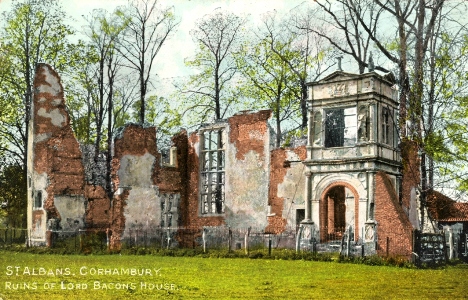
The ruins of Gorhambury that Sir Francis Bacon and Sir Harbottle Grimston would have lived in, the current residence having been built in the mid-eighteenth century.
So there I will leave it for now, just a brief insight into how I came to decide on the book I am writing. I will post a few articles over the next week or so, as it will help me to put thoughts and ideas out there, and any who has knowledge of material they believe will be useful, please feel free to share with me.
I did my degree, many years ago, in history and politics, so thought the I'd try and combine the two, and with Colchester having such a rich past, I decided that a bit of local history would fit the bill. With my Latin and ancient British languages being non-existent, I decided to eschew the Roman era, and go for something much more recent.
Now for those of us who consider ourselves historians, modern does not mean now, or even within the last fifty years or so, but can include what many consider, a long time ago. When I did my original degree at Essex University, they considered the 'early modern period' to have started in 1485, at the beginning of the Tudor era (which I will still use despite Clifford Davies's protestations) and finally ends around 1750, the beginning of industrialisation in Britain.
Seeing as I was going local, I thought okay, now Colchester actually played a part in what are called the English Civil Wars, or even as 'The Wars of the Three Kingdoms' seeing as Ireland and Scotland became heavily involved.
Colchester's most famous contribution is the siege, which lasted from 12 June-28 August 1648, when a troop of Royalist soldiers managed to barricade themselves inside the town walls, and Parliamentary troops led by Sir Thomas Fairfax blockaded the town. Eventually, after much privation the Royalist troops surrendered, and two of their commanders, Sir Charles Lucas and Sir George Lisle, were summarily executed behind the castle. My picture for this blog was taken next to the monument raised in 1892.
However, the siege has featured prominently in the myriad books about the wars, and for my first effort I wanted to do something I thought might be easier. I therefore decided to start trawling through Colchester's MPs, and the idea of writing short biographies of each appealed. I hadn't seen anything like that around, and thought it would be a good, and concise way of bringing together history and politics.
As I looked through, just drawing together a list, thinking perhaps selecting a number at specific points might be the way to go, I chanced upon the name of Sir Harbottle Grimston. Now this is a name to make anyone stop and look further into, so I did.
The more I delved, the more interesting he became. He was one of Colchester's MPs during the period of the conflicts, but had also ended up spending time in the Tower of London, and was actually the Speaker of the House of Commons which welcomed Charles II to England in 1660. He topped this off with becoming Master of the Rolls before dying in either 1685 or 1683 (depending on what you are reading) in St. Albans, and is buried alongside Sir Francis Bacon.
'So?' I asked myself, if this man did so much, why haven't I heard of him? I don't pretend to be an expert on the period, but you would think with having such an accomplished son, Colchester would have at least one monument of some sort, even if it was restricted to a blue plaque somewhere? But htere is absolutely nothing, bar a portrait in the Town Hall.
The portrait above of Sir Harbottle is by an unknown artist, but probably based upon a portrait by Sir Peter Lely. He is in the robes of the Master of the Rolls according to one source, although the National Portrait Gallery seems to think they are Speaker's.
As I began my researches, one thing I quickly discovered I had to be careful about was which Harbottle I was talking about. Father and son shared the same name, and were both Members of Parliament during the period from 1640 (when Charles I's personal rule ended) until 1647 when the first baronet died.
It was fairly simple to tell the difference in most documents and books where they are mentioned, because the first baronet is the one with the title. This could have been a lot trickier, if young Harbottle had been awarded the knighthood the eldest sons of baronets were normally awarded, but as he was in fact a second son, his elder brother having died, he possibly wasn't actually entitled to it.
These are the sort of questions I knew I would need to try and find answers to as I researched my biography, for by now I was so intrigued by this man, that I decided I might as well follow it through. After all, if there seems to be almost no trace of him in the town where he first appeared on the national scene, I thought there was an opportunity for something original.
I do not intend to go into too much detail about what I've discovered to date, and will save for specific blogs, and hopefully for the book, if it is ever published. But a few titbits that will hopefully interest you, and want you wanting to know more.
He first seems to have come to the notice of many outside parliament, when in a speech against Archbishop William Laud, he called him, " 'the sty of all pestilential filth that hath infested the state and government of this commonwealth,'' although this doesn't seem as original an insult as I believed for a long time, as Nehemiah Wallington used it, and it appears it may have been a puritan comment regarding those believed to be engaged in lustful activity, but more of that on another occasion.
Grimston appears now and again in books on the period, usually in reference to this speech, or in his role as Speaker during the Restoration. However, one historian who features him more extensively is John Adamson in his excellent 'The Noble Revolt' who also believes (as I have come to) that he is more significant than generally believed.
I have read one comment which describes Grimston as, 'almost a great man,' so my basis question I've asked myself is, Is Sir Harbottle Grimston deserving of greater recognition than he has hitherto received?
I thought that a good place to start, and I feel it enables me to view the materials with a dispassionate eye, as I always have that question in the back of my mind.
In Essex we have a superb records office, which holds quite a bit of material relating to the period, and some original letters to and from Grimston, and I am gradually wading through those, though I am having to practise reading seventeenth century handwriting, which is a bit of a job.
But the vast majority of primary resources are held at Hertford Record Office, as Grimston purchased the former home of Sir Francis Bacon, Gorhambury in St Albans, and so the records ended up being stored there. It's not too far away, but time and organisation is required so I have not yet been able to get there as often as I would like.
The ruins of Gorhambury that Sir Francis Bacon and Sir Harbottle Grimston would have lived in, the current residence having been built in the mid-eighteenth century.
So there I will leave it for now, just a brief insight into how I came to decide on the book I am writing. I will post a few articles over the next week or so, as it will help me to put thoughts and ideas out there, and any who has knowledge of material they believe will be useful, please feel free to share with me.
Friday, 16 March 2012
Some lessons are never learned....
I received a phone call this morning from someone I know very concerned. They had received a loan agreement from a high street bank, and it was just awaiting signature and return.
So I popped round, and looked at the agreement, which was badly printed, and had an offshore number as part of the address. This looked very strange,and when we tried to contact the freephone number it was unavailable.
Therefore, we rang the office of the bank my friend has an account with. After much tooing and froing, and misunderstandings, we finally got hold of the correct department. The matter was quickly cleared up, and what had happened was that because my friend had kept up to date with the payments on a previous loan, which is nearing its end, they just sent out a new one. My friend was advised to just throw it away and think nothing more of it. Of course, the bank could have avoided this problem by just including a covering letter explaining what this was all about, but it seems they have been taking lessons in communication from Andrew Lansley.
As you can imagine, this was all a relief, but it does demonstrate a much wider problem. We have been going through a severe financial crisis over the last few years, brought on by the behaviour of banks and other financial organisations, arguably the behaviour of governments, and the excessive debt levels of the man in the street. As Barack Obama repeated often during his 2008 election campaign, Wall Street gets a lot of the blame, but Main Street has played its role too.
Credit became easy to get, not only from banks but from other sources, and the so-called 'sub-prime' mortgages were a timebomb waiting to explode. I won't go over the ins and outs of the crisis, as they have been explored ad infinitum, and will be debated for years to come.
My point is that despite everything that has happened, and the economic and political consequences the banks do not seem to have learned their lesson. We have had a lot of discussion in recent months over banker's bonuses, and how those at the top often seem more concerned about their own pay packets.
But as I have already alluded to, access to easy credit, and the huge amounts of personal debt, have also been prime contributors to the problems we are now enduring. So why are banks not only offering unsolicited loans to account holders, but with the base rate at 0.5% (which has been in place for some three years now, and not just since the coalition came in, despite what David Cameron says) but have APR's of 19.1%?
Unfortunately not everyone is in the position of my friend, who is determined not to acquire more debts, but so many out there may feel they have no option but to take these on. Therefore, we are in severe danger of just going round in circles, and building up billions in personal debt all over again.
Incidentally, government's don't seem to learn particularly well either, as Labour's quantitative easing had nowhere near the stimulating effect it should have, and the coalition are just pumping more in. The banks just sit on it and boost their reserves, instead of lending it to businesses so they can expand and create jobs.
So the same set of circumstances that caused the initial crisis are in danger of being repeated, as banks attempt to tempt customers with easy credit at high rates of interest, and the government offers 95% mortgages. Hopefully this will spur the home buying market back into action, but it could also be storing up more problems down the line.
As ABBA so wisely sang in 1973, 'The history book on the shelf, is always repeating itself...,' and if banks especially don't do something to change their behaviour, then we could all be heading for a second financial Waterloo.
So I popped round, and looked at the agreement, which was badly printed, and had an offshore number as part of the address. This looked very strange,and when we tried to contact the freephone number it was unavailable.
Therefore, we rang the office of the bank my friend has an account with. After much tooing and froing, and misunderstandings, we finally got hold of the correct department. The matter was quickly cleared up, and what had happened was that because my friend had kept up to date with the payments on a previous loan, which is nearing its end, they just sent out a new one. My friend was advised to just throw it away and think nothing more of it. Of course, the bank could have avoided this problem by just including a covering letter explaining what this was all about, but it seems they have been taking lessons in communication from Andrew Lansley.
As you can imagine, this was all a relief, but it does demonstrate a much wider problem. We have been going through a severe financial crisis over the last few years, brought on by the behaviour of banks and other financial organisations, arguably the behaviour of governments, and the excessive debt levels of the man in the street. As Barack Obama repeated often during his 2008 election campaign, Wall Street gets a lot of the blame, but Main Street has played its role too.
Credit became easy to get, not only from banks but from other sources, and the so-called 'sub-prime' mortgages were a timebomb waiting to explode. I won't go over the ins and outs of the crisis, as they have been explored ad infinitum, and will be debated for years to come.
My point is that despite everything that has happened, and the economic and political consequences the banks do not seem to have learned their lesson. We have had a lot of discussion in recent months over banker's bonuses, and how those at the top often seem more concerned about their own pay packets.
But as I have already alluded to, access to easy credit, and the huge amounts of personal debt, have also been prime contributors to the problems we are now enduring. So why are banks not only offering unsolicited loans to account holders, but with the base rate at 0.5% (which has been in place for some three years now, and not just since the coalition came in, despite what David Cameron says) but have APR's of 19.1%?
Unfortunately not everyone is in the position of my friend, who is determined not to acquire more debts, but so many out there may feel they have no option but to take these on. Therefore, we are in severe danger of just going round in circles, and building up billions in personal debt all over again.
Incidentally, government's don't seem to learn particularly well either, as Labour's quantitative easing had nowhere near the stimulating effect it should have, and the coalition are just pumping more in. The banks just sit on it and boost their reserves, instead of lending it to businesses so they can expand and create jobs.
So the same set of circumstances that caused the initial crisis are in danger of being repeated, as banks attempt to tempt customers with easy credit at high rates of interest, and the government offers 95% mortgages. Hopefully this will spur the home buying market back into action, but it could also be storing up more problems down the line.
As ABBA so wisely sang in 1973, 'The history book on the shelf, is always repeating itself...,' and if banks especially don't do something to change their behaviour, then we could all be heading for a second financial Waterloo.
Wednesday, 14 March 2012
Respecting the public's views - An MP replies on the Health and Social Care Bill
Like many ordinary people over the last few weeks and months, I have been doing my bit to try and halt the Health and Social Care Bill, which is now on its final stages through the House of Lords before gaining royal assent.
Last week the government lost an appeal against an ruling from the Information Commissioner that they should publish the Transitional Risk Register. In yesterday's debate on the 'drop the bill' epetition, Andrew Lansley said he wouldn't be doing so until the tribunal published its reasons. I expect that once that happens, he will then appeal to the High Court, and during the ensuing delay, the bill will become law.
With this in mind, Lord Owen, a former GP, and Labour Foreign Secretary in the Callaghan government, has tabled an amendment for debate next Monday asking that the bill be paused, until the Risk Register has been published, so all aspects can be properly considered. This amendment will almost certainly be defeated, unless a number of Liberal Democrat peers, and a large proportion of the cross-benchers support it. Hopefully sufficient consciences will be pricked to support it.
This all goes against David Cameron's recent pronouncements that his government will be known for its transparency, though recent rumours that the government is seeking to amend the Freedom of Information Act, and perhaps start charging for it, doesn't inspire much confidence.
Anyway, this debate has been much discussed, and will be over the years, as the HSC Act begins to affect the way health services are provided in England (Wales, Scotland and Northern Ireland run their own affairs.
What I intend to just mention today is the way many MPs have responded to this campaign. In that vein, I would like to pay tribute to the many who have tried to engage properly with correspondents, and not just tried to fob them off because they aren't constituents.
I wrote principly to Liberal Democrat MPs, and recieved many courteous replies, explaining their positions and dilemmas, particularly Stephen Gilbert, Charles Kennedy and Tim Farron. I will also mention is despatches Nick de Bois who was happy to correspond via twitter.
I beleive this shows MPs at their best, willing to engage with the public over issues, and not pretending they are just there to be told what to do. I know many of my colleagues who also campaigned can speak of similar experiences. So below I will post the reply I recieved from Tim Farron, as I made a last ditch attempt at persuasion this week.
I do not agree with much of what Tim says, but he deserves great respect fro taking the time to reply properly, to me and no doubt many other correspondents. This is in marked contrast to my own Conservative MP Priti Patel, who I wrote to a number of weeks ago, and did not even deign to acknowlege my email. That is until I complained and copied the mail to the cheif whip, when I recieved a rather snippy reply from an adviser. To date that is the only reply I have had.
So, again I pay tribute to those MPs from all parties who took the time, and had the courtesy to reply to all correspondents, despite having been deluged over recent weeks. This is Tim's reply:
Dear Mr Hough,
Thank you very much for your message on the Government’s NHS Bill. I am aware that in your correspondence you raised some specific concerns. As you can understand, I have been inundated with correspondence on this matter and therefore it would take a huge amount of time for me to respond to each and every point, but thought it might be useful to outline my position on this Bill here.
I share your deep concern about this Bill. You may know that I did not vote with the Government on this Bill when it was last in the House of Commons. I was a critic of Labour’s competition reforms when they were in power and I am equally critical of these reforms.
When I am in Parliament, my approach is to try and make a difference, and so if I disagree with a Bill I will try to stop it, but I will also be pragmatic and do everything within my power, using amendments and parliamentary procedure, to make such a Bill better – that’s what I did when my party was in opposition and it is what I do now. That has been my approach on the Health and Social Care Bill. I don’t like the Bill, but I have also worked very hard to amend it beyond all recognition. This is not Andrew Lansley’s Bill of 14 months ago, yet almost all of the complaints I receive are from people who do not see how vastly different it is now.
The NHS is financially unsustainable in its present form because the increase in life expectancy and in the cost of medical treatments means that either the NHS drives down costs and is more efficient or else we will end up in the horrific situation of rationing. But whilst reform of the NHS is clearly vital, this Bill obviously has not secured the confidence of the British people or of the medical professions. For those reasons I will continue to vote for amendments to improve the Bill but I will not vote to endorse it.
Having said all of that, I hope you will take my word – without spin or partisan presentation - that this Bill is almost infinitely better than it was 14 months ago when it was first introduced (if that wasn’t true, I really wouldn’t insult you by trying to pull the wool over your eyes). A staggering one hundred and forty amendments were made to this Bill, mostly submitted by Liberal Democrats with some support from Labour and Conservative backbenchers. Whatever you think of the Bill, it would be unfair to ignore the impact that these amendments have made – especially when it comes to undoing the privatisation that Labour did to our NHS via the NHS Act 2006 and blocking the privatisation that the Conservatives have been pressing to include in the Bill.
It is also important to remember that the Bill contains important elements that protect the NHS from the effects of Labour’s privatisations. The 2006 Labour NHS Act let competition out of the bag – competition on price and not quality. For instance, my local hospital has a private surgical unit and we have a privatised out of hours GP unit all as a result of Labour reforms. This Bill contains new regulations to prevent private providers getting the advantages they were given by Labour. So, politically, it’s really tempting to want to ‘kill the Bill’, but anyone who wants to prevent US style competition should want those parts of the competition chapter of the Bill passed.
Here is a short list of some of the critical changes we have made to this Bill:
· reigned in the Tory’s instinct for competition without control by demanding that any competition is entirely based on quality and not price. Patients will be able to choose which care they receive, but this choice will be driven by quality and not by how much it costs to provide it. This contrasts sharply with Labour’s reforms which emphasised competition on the basis of price and which saw private providers being given a 14% premium over NHS providers.
· realigned the purpose of the health regulator Monitor so that it promotes the interests of patients, and not competition, as an end in itself – again, a huge step forward from the competition-focus that Labour left us with and which Mr Lansley wanted. Without this change, there was a real danger that Monitor could end up defending the interests of providers over patients. Thankfully, this danger has been averted.
· made sure that there are much clearer lines of accountability to local authorities and communities, so that clinical experts making the decisions about which health services to provide locally will have to be open about how and why they make their decisions. Some senior clinicians base their opposition to the Bill on their concern that these new lines of accountability will make it too hard for them to close hospitals – something I haven’t heard Labour talk about in public!
· insisted that Foundation Trusts have to demonstrate how the money raised from private income is being used to improve services for NHS patients as part of their annual report. At the moment, thanks to Labour reforms, private income can be solely pocketed by shareholders.
· established a stronger, clearer line of accountability of the NHS to the Secretary of State and to Parliament.
· changed GP commissioning groups Clinical Commissioning Groups, which means that other clinical professions e.g. nurses, pharmacists, physios etc. must be on the group.
· require the Secretary of State, NHS Commissioning Board and CCGs to not only tackle health inequalities, but also to report annually on their progress towards this goal.
· ensure the Secretary of State has a duty to secure comprehensive health care for the whole population and ensure that Clinical Commissioning Groups (CCGs) fulfil this duty.
· require each provider of healthcare services to co-operate with other providers of health and social care services.
· make it clear that the health regulator Monitor has the power to require healthcare providers to promote integration of NHS services.
· make sure patients have a greater say in their health, with the NHS Commissioning Board and CCGs having stronger duties to promote patient involvement in their own care.
I will keep fighting to protect our NHS and to keep it public.
Best wishes,
Tim Farron
Last week the government lost an appeal against an ruling from the Information Commissioner that they should publish the Transitional Risk Register. In yesterday's debate on the 'drop the bill' epetition, Andrew Lansley said he wouldn't be doing so until the tribunal published its reasons. I expect that once that happens, he will then appeal to the High Court, and during the ensuing delay, the bill will become law.
With this in mind, Lord Owen, a former GP, and Labour Foreign Secretary in the Callaghan government, has tabled an amendment for debate next Monday asking that the bill be paused, until the Risk Register has been published, so all aspects can be properly considered. This amendment will almost certainly be defeated, unless a number of Liberal Democrat peers, and a large proportion of the cross-benchers support it. Hopefully sufficient consciences will be pricked to support it.
This all goes against David Cameron's recent pronouncements that his government will be known for its transparency, though recent rumours that the government is seeking to amend the Freedom of Information Act, and perhaps start charging for it, doesn't inspire much confidence.
Anyway, this debate has been much discussed, and will be over the years, as the HSC Act begins to affect the way health services are provided in England (Wales, Scotland and Northern Ireland run their own affairs.
What I intend to just mention today is the way many MPs have responded to this campaign. In that vein, I would like to pay tribute to the many who have tried to engage properly with correspondents, and not just tried to fob them off because they aren't constituents.
I wrote principly to Liberal Democrat MPs, and recieved many courteous replies, explaining their positions and dilemmas, particularly Stephen Gilbert, Charles Kennedy and Tim Farron. I will also mention is despatches Nick de Bois who was happy to correspond via twitter.
I beleive this shows MPs at their best, willing to engage with the public over issues, and not pretending they are just there to be told what to do. I know many of my colleagues who also campaigned can speak of similar experiences. So below I will post the reply I recieved from Tim Farron, as I made a last ditch attempt at persuasion this week.
I do not agree with much of what Tim says, but he deserves great respect fro taking the time to reply properly, to me and no doubt many other correspondents. This is in marked contrast to my own Conservative MP Priti Patel, who I wrote to a number of weeks ago, and did not even deign to acknowlege my email. That is until I complained and copied the mail to the cheif whip, when I recieved a rather snippy reply from an adviser. To date that is the only reply I have had.
So, again I pay tribute to those MPs from all parties who took the time, and had the courtesy to reply to all correspondents, despite having been deluged over recent weeks. This is Tim's reply:
Dear Mr Hough,
Thank you very much for your message on the Government’s NHS Bill. I am aware that in your correspondence you raised some specific concerns. As you can understand, I have been inundated with correspondence on this matter and therefore it would take a huge amount of time for me to respond to each and every point, but thought it might be useful to outline my position on this Bill here.
I share your deep concern about this Bill. You may know that I did not vote with the Government on this Bill when it was last in the House of Commons. I was a critic of Labour’s competition reforms when they were in power and I am equally critical of these reforms.
When I am in Parliament, my approach is to try and make a difference, and so if I disagree with a Bill I will try to stop it, but I will also be pragmatic and do everything within my power, using amendments and parliamentary procedure, to make such a Bill better – that’s what I did when my party was in opposition and it is what I do now. That has been my approach on the Health and Social Care Bill. I don’t like the Bill, but I have also worked very hard to amend it beyond all recognition. This is not Andrew Lansley’s Bill of 14 months ago, yet almost all of the complaints I receive are from people who do not see how vastly different it is now.
The NHS is financially unsustainable in its present form because the increase in life expectancy and in the cost of medical treatments means that either the NHS drives down costs and is more efficient or else we will end up in the horrific situation of rationing. But whilst reform of the NHS is clearly vital, this Bill obviously has not secured the confidence of the British people or of the medical professions. For those reasons I will continue to vote for amendments to improve the Bill but I will not vote to endorse it.
Having said all of that, I hope you will take my word – without spin or partisan presentation - that this Bill is almost infinitely better than it was 14 months ago when it was first introduced (if that wasn’t true, I really wouldn’t insult you by trying to pull the wool over your eyes). A staggering one hundred and forty amendments were made to this Bill, mostly submitted by Liberal Democrats with some support from Labour and Conservative backbenchers. Whatever you think of the Bill, it would be unfair to ignore the impact that these amendments have made – especially when it comes to undoing the privatisation that Labour did to our NHS via the NHS Act 2006 and blocking the privatisation that the Conservatives have been pressing to include in the Bill.
It is also important to remember that the Bill contains important elements that protect the NHS from the effects of Labour’s privatisations. The 2006 Labour NHS Act let competition out of the bag – competition on price and not quality. For instance, my local hospital has a private surgical unit and we have a privatised out of hours GP unit all as a result of Labour reforms. This Bill contains new regulations to prevent private providers getting the advantages they were given by Labour. So, politically, it’s really tempting to want to ‘kill the Bill’, but anyone who wants to prevent US style competition should want those parts of the competition chapter of the Bill passed.
Here is a short list of some of the critical changes we have made to this Bill:
· reigned in the Tory’s instinct for competition without control by demanding that any competition is entirely based on quality and not price. Patients will be able to choose which care they receive, but this choice will be driven by quality and not by how much it costs to provide it. This contrasts sharply with Labour’s reforms which emphasised competition on the basis of price and which saw private providers being given a 14% premium over NHS providers.
· realigned the purpose of the health regulator Monitor so that it promotes the interests of patients, and not competition, as an end in itself – again, a huge step forward from the competition-focus that Labour left us with and which Mr Lansley wanted. Without this change, there was a real danger that Monitor could end up defending the interests of providers over patients. Thankfully, this danger has been averted.
· made sure that there are much clearer lines of accountability to local authorities and communities, so that clinical experts making the decisions about which health services to provide locally will have to be open about how and why they make their decisions. Some senior clinicians base their opposition to the Bill on their concern that these new lines of accountability will make it too hard for them to close hospitals – something I haven’t heard Labour talk about in public!
· insisted that Foundation Trusts have to demonstrate how the money raised from private income is being used to improve services for NHS patients as part of their annual report. At the moment, thanks to Labour reforms, private income can be solely pocketed by shareholders.
· established a stronger, clearer line of accountability of the NHS to the Secretary of State and to Parliament.
· changed GP commissioning groups Clinical Commissioning Groups, which means that other clinical professions e.g. nurses, pharmacists, physios etc. must be on the group.
· require the Secretary of State, NHS Commissioning Board and CCGs to not only tackle health inequalities, but also to report annually on their progress towards this goal.
· ensure the Secretary of State has a duty to secure comprehensive health care for the whole population and ensure that Clinical Commissioning Groups (CCGs) fulfil this duty.
· require each provider of healthcare services to co-operate with other providers of health and social care services.
· make it clear that the health regulator Monitor has the power to require healthcare providers to promote integration of NHS services.
· make sure patients have a greater say in their health, with the NHS Commissioning Board and CCGs having stronger duties to promote patient involvement in their own care.
I will keep fighting to protect our NHS and to keep it public.
Best wishes,
Tim Farron
Sunday, 12 February 2012
A Hare-brained government!
"Friends are arguing about whether this is the worst government since 1945. It certainly seems so. Blair’s administration did the single worst thing by invading Iraq, and Eden’s got the worst comeuppance, after invading Suez. But there’s been none in my lifetime that so resembles a team about to drop into the Conference. You look around the field and the players are all kicking the mud rather than the ball. Can anyone name a minister who’s had a good game? Even the free-spirited ones like Vince Cable and Kenneth Clarke lost all their vim the minute they got red boxes. Gove, Lansley and Duncan-Smith call to mind George Santayana’s definition of a fanatic: someone who redoubles his efforts after forgetting his aim. Hague merely seems bored, as though his brief — the world — weren’t as interesting to him as an elliptical machine. The disparity between Cameron’s moral lectures to the young and the ugliness of his own tongue dismays even his supporters. Osborne and Cameron represent class interest pure and simple. ‘Does it help us?’ is the only question they ever ask. Their dishonest strategy of blaming Labour for everything the bankers did wrong ran out of gas five miles back down the road. It will be interesting to see what new PR wangle they come up with next to disguise the failure of their own analysis."
The above quote comes from the diary section of this week's edition of The Spectator. The magazine tends to be Conservative supporting, in the same way the New Stateman leans towards the Labour Party.
David Hare is a neutral political observer, having written satirically on all politics for many years. I do not know which way he votes, and his appearnace in The Spectator is not evidence that he is a Conservative, as it often has articles by those from the opposite camp.
However, that they have allowed such a blatant attack on the government could be seen that they are unhappy with much that is going on. Editor Fraser Nelson has described the Health and Social Care Bill as amongst the top ten worst bills of the past decade.
I will allow David Hare's words to speak for themselves, but just to wind up, this government has already developed a reputation for poor drafting of bills, and David Cameron himself is noted for lacking attention to detail.
As an article in The Independent on January 29th so amply demonstrated, when it was revealed that plans for a second coalition with the Liberal Democrats hasve been dumped and, "a new agreement has been abandoned because ministers realise running the country is harder than they had thought."
A senior cabinet minister said, ""We have realised that governing is more than just passing legislation. We really need to focus on ensuring they [the laws] work so we can go to voters with proof that we have made a difference."
So right from day one the Conservatives didn't know what they were doing, and the Liberal Democrats shell-shocked by finding themselves in a position of responsibility, were just unable to step up.
The above quote comes from the diary section of this week's edition of The Spectator. The magazine tends to be Conservative supporting, in the same way the New Stateman leans towards the Labour Party.
David Hare is a neutral political observer, having written satirically on all politics for many years. I do not know which way he votes, and his appearnace in The Spectator is not evidence that he is a Conservative, as it often has articles by those from the opposite camp.
However, that they have allowed such a blatant attack on the government could be seen that they are unhappy with much that is going on. Editor Fraser Nelson has described the Health and Social Care Bill as amongst the top ten worst bills of the past decade.
I will allow David Hare's words to speak for themselves, but just to wind up, this government has already developed a reputation for poor drafting of bills, and David Cameron himself is noted for lacking attention to detail.
As an article in The Independent on January 29th so amply demonstrated, when it was revealed that plans for a second coalition with the Liberal Democrats hasve been dumped and, "a new agreement has been abandoned because ministers realise running the country is harder than they had thought."
A senior cabinet minister said, ""We have realised that governing is more than just passing legislation. We really need to focus on ensuring they [the laws] work so we can go to voters with proof that we have made a difference."
So right from day one the Conservatives didn't know what they were doing, and the Liberal Democrats shell-shocked by finding themselves in a position of responsibility, were just unable to step up.
Saturday, 11 February 2012
Cameron's Risky Strategy!
David Cameron and the Conservative led government have had a really bad start to 2012, yet they have brought it all on themselves. Things started so well too, leading in the polls on the back of the Prime Minister's apparent veto at the European Union summit last December. Then a series of policy announcements and speeches from Labour leader Ed Miliband and his shadow Chancellor Ed Balls, seemed to upset the unions, and many supporters, which meant the Labour party seemed to be arguing within itself, rather than challenging the government.
Since those early days, which must seem a long time ago now for the Conservatives and David Cameron has found themselves under pressure on several fronts.
Economic figures have been gloomy, with increasing unemployment, and then when the fourth quarter GDP figures showed a contraction of 0.2% (something which Osborne spent the previous few days preparing us for), on top of all the forecast downgrades for growth, things started to turn against David Cameron and the government.
It began with the Welfare Reform Bill, as a series of defeats in the House of Lords on disability payments for children amongst others, put the government on the back foot. The coalition of Labour and crossbench peers, along with a number of Liberal Democrats, being enough to vote through amendments.
The government was able to reverse these defeats when the bill returned to the Commons, but they then evoked 'financial privilege to prevent it being sent back to the Lords,' the main point being:
"The Commons' claim to sole rights in respect of financial legislation applies indivisibly to public expenditure and to the raising of revenue to meet that expenditure. ... The Commons treat as a breach of privilege by the Lords not merely the imposition or increase of such a charge but also any alteration, whether by increase or reduction, of its amount or of its duration, mode of assessment, levy, collection, appropriation or management ..."
as stated in Erskine May. Therefore, the government is telling the House of Lords that they believe that only they have the right to decide on bills, or clauses, which the Lords feel are unfair, but have huge financial implications. It could be argued that the evoking of this, little used, rule, is an attempt by the government to silence debate on an extremely contentious bill.
There are two sides to this argument, of course, and as a supporter of a fully elected upper house, I do believe the Commons, as the elected body, should have the ultimate say on bills the government wishes to pass. However, the Lords does act as a revising chamber, and evoking financial privilege just looks like the government is running away from the argument.
David Cameron's second issue has been the EU (a running sore for the Conservative Party) and whether or not the Prime Minister has reined back from the boasts he was making following last year's summit, that gave him such a boost in popularity amongst his own forces.
On Wednesday January 25th Ed Miliband is generally have believed to have had the best of the exchanges at Prime Minister's Questions, and he followed it up the next Monday with what many believe was his best performance as leader, as he ripped into David Cameron over his perceived reining back at the previous weekend's summit. Even the vehemently anti-Ed Miliband blogger Paul Staines (in his alter ego Guido Fawkes) said that, 'the boy done good.'
It doesn't actually matter whether Cameron did make any new concessions at the summit, the perception is he did, and this has upset the large anti-EU bloc on the Conservative backbenches (and a couple in the cabinet), and Ed Miliband took advantage, remembered especially for the line, "The whole house now knows that a veto is not for life, it’s just for Christmas."
This was swiftly followed by another PMQs victory for Ed Miliband, and presciently the second set, on which he was adjudged to have certainly got the better of the Prime Minister was the Health and Social Care Bill.
It is this bill that is now causing David Cameron his biggest headache, as the opposition to it increases, seemingly by the day. What makes it worse for him, and the Health Secretary Andrew Lansley, is that the calls to drop the bill do not all come from the usual suspects.
The Labour Party are against it, because they see it as a big step on the road to privatisation. It is true that GPs were allowed greater say in where their patients went under the last government, but the bill would enable much greater private involvement, and doctor's surgeries would become small businesses, and doctors more concerned with profit margins than caring for their patients.. This along with 49% of hospital beds being available to private patients (if hospitals wish to) just adds to that perception.
But the real damage is that virtually everyone involved in the medical profession, outside of private health companies seems to be against it. Andrew Lansley's office, before the 2010 election, received large donations from Care UK, a private health provider, which adds to the speculation that these companies have a big influence in drawing up this legislation. To cap it all Hinchingbrooke Hospital (which had had many many problems) has now been taken over by Circle, and although this is a company with a good record, and as a result has met with less opposition than you might think, it is seen as a toe in the door.
On top of this opposition, which Lansley tend to dismiss as 'vested interests' not something likely to endear him to the medical profession, is that coming from his own side. Tim Montgomerie, of the ConservativeHome blog has said the government should drop the bill, "The unnecessary and unpopular NHS Bill could cost the Conservative Party the next election. Cameron must kill it."
This is a really big problem for David Cameron and Andrew Lansley, in that a coalition of sorts is building against the Health and Social care Bill, from opposite sides, and for different reasons; creeping privatisation or election losing, but united in that the bill should be withdrawn.
Last night (Friday 10th February) Ryan Bourne of the Centre for Policy Studies (speaking in a personal capacity), said that he found the attacks on Andrew Lansley hard to stomach. However, it wasn't the Labour Party, medical profession or even ConservativeHome (which has a reputation for independent thought anyway), but the Conservatives in the cabinet.
He believes, with some justification I think, that they are showing weakness by, 'now jumping ship,' once things got a bit rough. Indeed, Tim Montgomerie has said that three of them (anonymously) practically ordered him to write it. If they had opposed the bill from the start they should have made their views clear. I think Tim Montgomerie can't be faulted really, he's not come out against many of the changes proposed, but is honest that it should be ditched, because it could be an election loser.
David Cameron for the time being is saying he will force the bill through, but things could come to a head on February 22nd, when Andy Burnham (shadow Health Secretary) has called an opposition day debate on the risk register. This is a document widely used in government, business and other organisations to evaluate wat problems may arise from a particular policy.
Andrew Lansley has been reluctant to publish the register, despite being ordered to do so by the Information Commissioner last November. As a result, it is believed that the Health secretary has something to hide, particularly as the register is propounded to state the reforms would drive up costs in the health service. He doesn't help his case either by stating that the register isn't being published because releasing it, "would have jeopardised the success of the policy."
Now if I was a cynic, I might think that the Health Secretary, with the encouragement of the Prime Minister, was willing to block, delay and obfuscate to get his bill through parliament.
However, I really believe this is an issue about democracy, regardless of whether you support the bill or not. This government is always harping on about greater transparency, and yet they seem to be disobeying a direct order from the Information Commissioner to publish. The House of Lords are currently debating the bill, yet Lansley is refusing to make available all the information to enable them to debate with all the facts.
An Early Day Motion asking that the risk register be published, sponsored by Labour's Easington MP Grahame Morris, has cross party support, excepting as yet Conservatives, which indicates that this is not just a party political issue.
So why is David Cameron trying so hard to keep Andrew Lansley? He seems to have alienated for various reasons the vast majority of the medical profession, and large swathes of his natural supporters. If Montgomerie is correct, by hanging onto him, and trying to push the bill through, Cameron is turning the possibility of losing the next election, into a very likely event.
He daren't risk Andrew Lansley resigning over the issue, because it would be the second in a fairly short space of time (following Chris Huhne's recent one after he was charged with perverting the course of justice), and the fourth in less than two years in government. Although two were Liberal Democrats, it will just give the impression of a government rife with scandal and in disarray.
David Cameron, therefore finds himself in a very difficult position as the year progresses. He is under fire from his own side because he didn't veto an EU treaty after all, he's losing the argument in the public face of Parliament Prime Minister's Questions far too often, he's losing votes regularly in the Lords (with a large number of those who served in Margaret Thatcher's cabinets amongst rebels), and he has a bill which Fraser Nelson, editor of The Spectator, described as one of the ten worst bills of the last decade.
Hubris is a fickle friend, and throughout his Premiership David Cameron has demonstrated plenty of it. But now it could well be his downfall, if not forcing him out, but sending his government spiralling towards defeat at the next election.
Three years is a long time, and fortunes will ebb and flow over that period. But the Prime Minister has a big calculation to make over the next thirteen days. Drop the Health and Social care Bill, and take the temporary hit, even if it means losing his Health secretary in the process. Or he can plough on, and face the prospect of losing the vote called by Labour on the risk register, and the subsequent fallout from that which could make the damage irreparable.
Yet it could all have been so easily avoided. If David Cameron had stuck to his manifesto promise, "that there'd be no top down reorganisation of the NHS," or had not made such a point of refusing to sign up in December's EU summit, or was prepared to rein back on the cuts that are causing so much pain.. The problems are all of his own making, but he is a man who doesn't admit to mistakes, and will just continue on the same path whatever the outcome.
Since those early days, which must seem a long time ago now for the Conservatives and David Cameron has found themselves under pressure on several fronts.
Economic figures have been gloomy, with increasing unemployment, and then when the fourth quarter GDP figures showed a contraction of 0.2% (something which Osborne spent the previous few days preparing us for), on top of all the forecast downgrades for growth, things started to turn against David Cameron and the government.
It began with the Welfare Reform Bill, as a series of defeats in the House of Lords on disability payments for children amongst others, put the government on the back foot. The coalition of Labour and crossbench peers, along with a number of Liberal Democrats, being enough to vote through amendments.
The government was able to reverse these defeats when the bill returned to the Commons, but they then evoked 'financial privilege to prevent it being sent back to the Lords,' the main point being:
"The Commons' claim to sole rights in respect of financial legislation applies indivisibly to public expenditure and to the raising of revenue to meet that expenditure. ... The Commons treat as a breach of privilege by the Lords not merely the imposition or increase of such a charge but also any alteration, whether by increase or reduction, of its amount or of its duration, mode of assessment, levy, collection, appropriation or management ..."
as stated in Erskine May. Therefore, the government is telling the House of Lords that they believe that only they have the right to decide on bills, or clauses, which the Lords feel are unfair, but have huge financial implications. It could be argued that the evoking of this, little used, rule, is an attempt by the government to silence debate on an extremely contentious bill.
There are two sides to this argument, of course, and as a supporter of a fully elected upper house, I do believe the Commons, as the elected body, should have the ultimate say on bills the government wishes to pass. However, the Lords does act as a revising chamber, and evoking financial privilege just looks like the government is running away from the argument.
David Cameron's second issue has been the EU (a running sore for the Conservative Party) and whether or not the Prime Minister has reined back from the boasts he was making following last year's summit, that gave him such a boost in popularity amongst his own forces.
On Wednesday January 25th Ed Miliband is generally have believed to have had the best of the exchanges at Prime Minister's Questions, and he followed it up the next Monday with what many believe was his best performance as leader, as he ripped into David Cameron over his perceived reining back at the previous weekend's summit. Even the vehemently anti-Ed Miliband blogger Paul Staines (in his alter ego Guido Fawkes) said that, 'the boy done good.'
It doesn't actually matter whether Cameron did make any new concessions at the summit, the perception is he did, and this has upset the large anti-EU bloc on the Conservative backbenches (and a couple in the cabinet), and Ed Miliband took advantage, remembered especially for the line, "The whole house now knows that a veto is not for life, it’s just for Christmas."
This was swiftly followed by another PMQs victory for Ed Miliband, and presciently the second set, on which he was adjudged to have certainly got the better of the Prime Minister was the Health and Social Care Bill.
It is this bill that is now causing David Cameron his biggest headache, as the opposition to it increases, seemingly by the day. What makes it worse for him, and the Health Secretary Andrew Lansley, is that the calls to drop the bill do not all come from the usual suspects.
The Labour Party are against it, because they see it as a big step on the road to privatisation. It is true that GPs were allowed greater say in where their patients went under the last government, but the bill would enable much greater private involvement, and doctor's surgeries would become small businesses, and doctors more concerned with profit margins than caring for their patients.. This along with 49% of hospital beds being available to private patients (if hospitals wish to) just adds to that perception.
But the real damage is that virtually everyone involved in the medical profession, outside of private health companies seems to be against it. Andrew Lansley's office, before the 2010 election, received large donations from Care UK, a private health provider, which adds to the speculation that these companies have a big influence in drawing up this legislation. To cap it all Hinchingbrooke Hospital (which had had many many problems) has now been taken over by Circle, and although this is a company with a good record, and as a result has met with less opposition than you might think, it is seen as a toe in the door.
On top of this opposition, which Lansley tend to dismiss as 'vested interests' not something likely to endear him to the medical profession, is that coming from his own side. Tim Montgomerie, of the ConservativeHome blog has said the government should drop the bill, "The unnecessary and unpopular NHS Bill could cost the Conservative Party the next election. Cameron must kill it."
This is a really big problem for David Cameron and Andrew Lansley, in that a coalition of sorts is building against the Health and Social care Bill, from opposite sides, and for different reasons; creeping privatisation or election losing, but united in that the bill should be withdrawn.
Last night (Friday 10th February) Ryan Bourne of the Centre for Policy Studies (speaking in a personal capacity), said that he found the attacks on Andrew Lansley hard to stomach. However, it wasn't the Labour Party, medical profession or even ConservativeHome (which has a reputation for independent thought anyway), but the Conservatives in the cabinet.
He believes, with some justification I think, that they are showing weakness by, 'now jumping ship,' once things got a bit rough. Indeed, Tim Montgomerie has said that three of them (anonymously) practically ordered him to write it. If they had opposed the bill from the start they should have made their views clear. I think Tim Montgomerie can't be faulted really, he's not come out against many of the changes proposed, but is honest that it should be ditched, because it could be an election loser.
David Cameron for the time being is saying he will force the bill through, but things could come to a head on February 22nd, when Andy Burnham (shadow Health Secretary) has called an opposition day debate on the risk register. This is a document widely used in government, business and other organisations to evaluate wat problems may arise from a particular policy.
Andrew Lansley has been reluctant to publish the register, despite being ordered to do so by the Information Commissioner last November. As a result, it is believed that the Health secretary has something to hide, particularly as the register is propounded to state the reforms would drive up costs in the health service. He doesn't help his case either by stating that the register isn't being published because releasing it, "would have jeopardised the success of the policy."
Now if I was a cynic, I might think that the Health Secretary, with the encouragement of the Prime Minister, was willing to block, delay and obfuscate to get his bill through parliament.
However, I really believe this is an issue about democracy, regardless of whether you support the bill or not. This government is always harping on about greater transparency, and yet they seem to be disobeying a direct order from the Information Commissioner to publish. The House of Lords are currently debating the bill, yet Lansley is refusing to make available all the information to enable them to debate with all the facts.
An Early Day Motion asking that the risk register be published, sponsored by Labour's Easington MP Grahame Morris, has cross party support, excepting as yet Conservatives, which indicates that this is not just a party political issue.
So why is David Cameron trying so hard to keep Andrew Lansley? He seems to have alienated for various reasons the vast majority of the medical profession, and large swathes of his natural supporters. If Montgomerie is correct, by hanging onto him, and trying to push the bill through, Cameron is turning the possibility of losing the next election, into a very likely event.
He daren't risk Andrew Lansley resigning over the issue, because it would be the second in a fairly short space of time (following Chris Huhne's recent one after he was charged with perverting the course of justice), and the fourth in less than two years in government. Although two were Liberal Democrats, it will just give the impression of a government rife with scandal and in disarray.
David Cameron, therefore finds himself in a very difficult position as the year progresses. He is under fire from his own side because he didn't veto an EU treaty after all, he's losing the argument in the public face of Parliament Prime Minister's Questions far too often, he's losing votes regularly in the Lords (with a large number of those who served in Margaret Thatcher's cabinets amongst rebels), and he has a bill which Fraser Nelson, editor of The Spectator, described as one of the ten worst bills of the last decade.
Hubris is a fickle friend, and throughout his Premiership David Cameron has demonstrated plenty of it. But now it could well be his downfall, if not forcing him out, but sending his government spiralling towards defeat at the next election.
Three years is a long time, and fortunes will ebb and flow over that period. But the Prime Minister has a big calculation to make over the next thirteen days. Drop the Health and Social care Bill, and take the temporary hit, even if it means losing his Health secretary in the process. Or he can plough on, and face the prospect of losing the vote called by Labour on the risk register, and the subsequent fallout from that which could make the damage irreparable.
Yet it could all have been so easily avoided. If David Cameron had stuck to his manifesto promise, "that there'd be no top down reorganisation of the NHS," or had not made such a point of refusing to sign up in December's EU summit, or was prepared to rein back on the cuts that are causing so much pain.. The problems are all of his own making, but he is a man who doesn't admit to mistakes, and will just continue on the same path whatever the outcome.
Sunday, 15 January 2012
Defective defection?
I wish Luke Bozier well! If Luke truly believes that the Conservative Party is where his heart lies, then it is right for him to leave Labour and join them. I do not think he is a traitor, or any such terms if he is genuinely following his political heart.
Yet on only January 9th, in his last blog for Labour List he wrote, "Labour politics is meant to be the politics of care and attention to those in the world who need it, it’s about finding a vision of a better Britain and spreading opportunity as far and wide as possible. We have achieved lots in our time in office, but what purpose does it serve being the perpetual party of opposition?"
The Tory-led government is failing to provide that, 'care and attention to those who need it,' and as the reaction from both left and right to the Welfare Bill has demonstrated, this is felt across the board. So, we need to look for other reasons for Luke's defection.
In his interview in today's Independent, he says he believes that the reforming zeal of New Labour has now been picked up by David Cameron and the Conservative Party. That Cameron has moved onto New Labour territory is something many of us have been saying for the last two years. Therefore, it would seem only natural for Luke Bozier to join a party that seems much more in keeping with his beliefs.
On August 4th 2011, Luke wrote for Labour List an article entitled, "Does Labour need its own Tea Party movement," in which he more or less repeats the Conservative Party line that 'it's all Labour's fault,' and that Labour should follow polices of, 'legal limits on deficits, national debt ceilings and links between the deficit limit and the employment rate.'
Now this isn't to say Labour can't do better, any party that says it got everything right is deluding itself. However, Ed Miliband has said money could have been better spent, but that is not the same as saying we spent too much. And before any Conservative readers jump up and down, think about how much your government has wasted on multiple u-turns in the last eighteen months, and proposals to spend millions on a new royal yacht, and a possible state funeral for Margaret Thatcher.
Indeed, it could be argued that Luke has in fact moved further to the right than David Cameron, as he speaks of 'fiscal responsibility,' debt ceilings and the like.
In November last year he wrote in an article for Labour Uncut, "Nobody in politics seems to know how to fix the economy. The Tory-Lib Dem government is scrambling around trying to appear as though they are boosting it. Miraculously, in an era with very little money in the public coffers, the treasury seems to be able to find a billion here or a billion there to support half-baked pro-growth policies."
So now he seems willing to go and join a party he doesn't believe has any idea what it is doing. There is nothing wrong with promoting enterprise, but only a few months ago he didn't believe the Conservative Party was the party to promote it, and said of Ed Miliband:
"Things are starting to change for Labour. Since that TUC rally in March, Ed Miliband has slowly started to move closer to the centre ground, and we have realised as a party that until we’re seen as serious and leading the way on business and growth, we cannot win a general election. Chuka Umunna was promoted to shadow business secretary, a shrewd move by Ed M. It was wise to change the party rules in order to bring people like Umunna up more quickly. Chuka has a firm grasp of the business brief, and is serious about pushing Labour to be more comfortable with business."
He finished the article stating that the government was in disarray over how to fix the mess, and this was only two months ago. So what has led Luke Bozier to leave the Labour Party and join the Conservatives at this time?
The easy thing to do would be to say he was a Tory all along, and that like all Blairites we're better off without him, and them. I disagree with this rather knee jerk analysis.
There will be many Blairites who will look at Luke's actions with dismay. Not because they don't sympathise with his views, but because they still believe that Labour is still the best party to deliver their mix of social and economic concerns.
I think what we have is a young man who is politically confused, and unsure of the direction he really wants to go in. He's obviously a very intelligent and enterprising young man, who in his role as e-campaigns manager brought expertise, and worked hard to win the last General Election.
I expect he will find it hard to find a place in the Conservative Party, because although in some areas he may find allies, he joined Labour for a reason (if his protestation that he's not just following power is true) and not the Conservative Party (as David Cameron had already begun to make his changes by the time Luke became politically active), and he will find it more difficult to voice his concerns about the way policy on the NHS and welfare are going there. Luke my well believe public services need to be 'smarter' but whether he will feel entirely comfortable in a party that wishes to privatise them is another matter altogether.
As a supporter of Tony Blair and New Labour, it is understandable that he is frustrated with the Labour Party at the moment. Less than two years after a big defeat the party is taking its time to find its feet again. This is natural, the Conservatives took nine years following their defeat in 1997, and the Liberal Democrats (in their previous guise as the Liberals) took nearly a century. Labour won't take that long, but it is inevitably a painful process.
Last November Luke believed that Ed Miliband was moving in the right direction, but now that has changed. I think he detects a shift to the left and is unhappy with that, but if he believes the party, and its leader are failing to provide real opposition, it does seem odd for him to now join the party he's been opposing all this time, and does not have a clue what it is doing.
Perhaps the most significant words for most party members were, "The Labour Party today is not the Labour Party I joined six years ago when Tony Blair was leader." Many on the left of the party have complained there seems little movement away from Tony Blair's more neoliberal agenda. So this could be Luke Bozier's biggest contribution to the Labour Party, by defecting he's shown we have shifted decisively to the left, and are now in a position to provide that real alternative to the coalition.
So as he moves onto new pastures, I hope he finds what he is looking for, but I fear that he is just heading for more disappointment.
Yet on only January 9th, in his last blog for Labour List he wrote, "Labour politics is meant to be the politics of care and attention to those in the world who need it, it’s about finding a vision of a better Britain and spreading opportunity as far and wide as possible. We have achieved lots in our time in office, but what purpose does it serve being the perpetual party of opposition?"
The Tory-led government is failing to provide that, 'care and attention to those who need it,' and as the reaction from both left and right to the Welfare Bill has demonstrated, this is felt across the board. So, we need to look for other reasons for Luke's defection.
In his interview in today's Independent, he says he believes that the reforming zeal of New Labour has now been picked up by David Cameron and the Conservative Party. That Cameron has moved onto New Labour territory is something many of us have been saying for the last two years. Therefore, it would seem only natural for Luke Bozier to join a party that seems much more in keeping with his beliefs.
On August 4th 2011, Luke wrote for Labour List an article entitled, "Does Labour need its own Tea Party movement," in which he more or less repeats the Conservative Party line that 'it's all Labour's fault,' and that Labour should follow polices of, 'legal limits on deficits, national debt ceilings and links between the deficit limit and the employment rate.'
Now this isn't to say Labour can't do better, any party that says it got everything right is deluding itself. However, Ed Miliband has said money could have been better spent, but that is not the same as saying we spent too much. And before any Conservative readers jump up and down, think about how much your government has wasted on multiple u-turns in the last eighteen months, and proposals to spend millions on a new royal yacht, and a possible state funeral for Margaret Thatcher.
Indeed, it could be argued that Luke has in fact moved further to the right than David Cameron, as he speaks of 'fiscal responsibility,' debt ceilings and the like.
In November last year he wrote in an article for Labour Uncut, "Nobody in politics seems to know how to fix the economy. The Tory-Lib Dem government is scrambling around trying to appear as though they are boosting it. Miraculously, in an era with very little money in the public coffers, the treasury seems to be able to find a billion here or a billion there to support half-baked pro-growth policies."
So now he seems willing to go and join a party he doesn't believe has any idea what it is doing. There is nothing wrong with promoting enterprise, but only a few months ago he didn't believe the Conservative Party was the party to promote it, and said of Ed Miliband:
"Things are starting to change for Labour. Since that TUC rally in March, Ed Miliband has slowly started to move closer to the centre ground, and we have realised as a party that until we’re seen as serious and leading the way on business and growth, we cannot win a general election. Chuka Umunna was promoted to shadow business secretary, a shrewd move by Ed M. It was wise to change the party rules in order to bring people like Umunna up more quickly. Chuka has a firm grasp of the business brief, and is serious about pushing Labour to be more comfortable with business."
He finished the article stating that the government was in disarray over how to fix the mess, and this was only two months ago. So what has led Luke Bozier to leave the Labour Party and join the Conservatives at this time?
The easy thing to do would be to say he was a Tory all along, and that like all Blairites we're better off without him, and them. I disagree with this rather knee jerk analysis.
There will be many Blairites who will look at Luke's actions with dismay. Not because they don't sympathise with his views, but because they still believe that Labour is still the best party to deliver their mix of social and economic concerns.
I think what we have is a young man who is politically confused, and unsure of the direction he really wants to go in. He's obviously a very intelligent and enterprising young man, who in his role as e-campaigns manager brought expertise, and worked hard to win the last General Election.
I expect he will find it hard to find a place in the Conservative Party, because although in some areas he may find allies, he joined Labour for a reason (if his protestation that he's not just following power is true) and not the Conservative Party (as David Cameron had already begun to make his changes by the time Luke became politically active), and he will find it more difficult to voice his concerns about the way policy on the NHS and welfare are going there. Luke my well believe public services need to be 'smarter' but whether he will feel entirely comfortable in a party that wishes to privatise them is another matter altogether.
As a supporter of Tony Blair and New Labour, it is understandable that he is frustrated with the Labour Party at the moment. Less than two years after a big defeat the party is taking its time to find its feet again. This is natural, the Conservatives took nine years following their defeat in 1997, and the Liberal Democrats (in their previous guise as the Liberals) took nearly a century. Labour won't take that long, but it is inevitably a painful process.
Last November Luke believed that Ed Miliband was moving in the right direction, but now that has changed. I think he detects a shift to the left and is unhappy with that, but if he believes the party, and its leader are failing to provide real opposition, it does seem odd for him to now join the party he's been opposing all this time, and does not have a clue what it is doing.
Perhaps the most significant words for most party members were, "The Labour Party today is not the Labour Party I joined six years ago when Tony Blair was leader." Many on the left of the party have complained there seems little movement away from Tony Blair's more neoliberal agenda. So this could be Luke Bozier's biggest contribution to the Labour Party, by defecting he's shown we have shifted decisively to the left, and are now in a position to provide that real alternative to the coalition.
So as he moves onto new pastures, I hope he finds what he is looking for, but I fear that he is just heading for more disappointment.
Subscribe to:
Posts (Atom)