Showing posts with label history. Show all posts

Sunday, 7 April 2013

Show me the Mani.....


            An Undivided Past: History Beyond our Differences by David Cannadine
            Allen Lane (an imprint of Penguin Books), London, 2013   

David Cannadine's 'The Undivided Past' is a tour de force attacking the simplification of arguments over the millennia into Manichean 'us versus them' debates. Perhaps ironically in attempting to makes this argument accessible to all, he also simplifies it but then all great books leave us wanting to know more, and encourage us to go and look for ourselves. To quote a series of well-known adverts on television, 'it does what it says on the tin,' as it explores its themes, but concludes that in fact our past is undivided, and we are more united than many would have us believe.


Cannadine's sees his task as to prove to us that this simple black and white view is not only incorrect, but in fact never has been. Indeed he seems to quite lose patience with those who read into actions or words what they want to, without looking at the subtleties within, or even the words and actions of those that are being quoted.

A good example is occurs in the chapter on 'Civilisation' when Cannadine explains how the American neoconservative and New Labour, specifically, used Samuel P. Huntington's Clash of Civilisations to justify their views that led to the invasions of Afghanistan and Iraq, but ignore the man's statements that he did not support the actions.

In the introduction he even has a dig at his own, academic, community:

Most academics are trained to look for divergences and disparities rather than for similarities and affinities,but this relentless urge to draw distinctions often results in important connections and resemblances being overlooked.

This seems an odd claim, as it is counter to what we would teach in school, in which students are encouraged to look for and identify themes of difference, but also of similarity as we seek to help them understand that history is not a simple exercise, but one that needs careful contemplation and an urge to understand the motivations and actions of others.

What Cannadine is really doing here is demonstrating how Manichean thinking has permeated the intellectual world, and that he believes this is a simplistic approach which runs counter to the evidence of the ages.


At the beginning of the book Cannadine uses quotes from the last two American Presidents before Obama, when he shows how George W. Bush said that as he grew up the view was that it was 'us versus them,' even though you weren't certain who 'they were.'

He contrasts this with his predecessor Bill Clinton who said conversely that although the world was often ruled by the belief that our differences were more important than our 'common humanity,' he actually believed, 'our common humanity is more important than our interesting and inevitable differences.'

It is apparent very early that it is Clinton's view that Cannadine has most sympathy with opening with:

This book sets out to explore and investigate the most resonant forms of human solidarity as they have been invented and created, established and sustained, questioned and denied, fissured and broken across the centuries and around the world, and as they have defined the lives, engaged the emotions, and influenced the fates of countless millions of individuals.


Cannadine does this by exploring what he considers to be the six 'most compelling and commonplace forms of such identities,' which are religion, nation, class, gender, race and civilisation. The scope of each argument is really quite astounding as he delves into the human condition over the millennia.

He demonstrates that Newton's third law applies to human interaction as well as the world of physics, 'every collective solidarity simultaneously creates an actual or potential antagonist out of the group or groups it excludes.'

In exploring his six themes, Cannadine draws upon scholarship from many sources but particular works play more prominent roles. Edward Gibbon's The History of the Decline and Fall of the Roman Empire, Arnold Toynbee's A Study of History being often quoted because they encompass so much of what he want s to say, and argue against.

But it is important to note that each chapter sweeps across time in a connected and clear way, as Cannadine looks at the arguments which demonstrates those Manichean themes, and yet shows us how wrong it is to see these arguments so simply, and that they are really excuses to explain our prejudices.

In the chapter on 'Gender,' as an example, he does indeed point out how women have been excluded from much of civil society by men over time, and how many writers such as Germaine Greer sought, at least in her early writings, to emphasise the differences in which women were fighting against men, in a Manichean, us versus them, struggle, whilst he counters that with Betty Freidan who saw it in more inclusive enterprise in which men and women fought together in a joint enterprise.


In looking at this debate across the centuries, Cannadine argues it would be simple to see it as an age old battle by women against the beliefs that women were incapable of being equal due to strength, intellect etc. yet in  The Republic Plato writes that a woman's destiny was not decided by her biology, but by the cultural impositions of men, and that women should be included fully in political social and cultural life and that it was very possible they could become philosopher rulers.

This is the general trait of each chapter, as Cannadine exposes the paucity of, as Cannadine believes, the Manichean thinkers, and demonstrates time and again that there have always existed, and been prominent those who have sought to argue that our differences are indeed merely 'skin deep,' and that what unites across these great themes is greater than what divides us.  


Cannadine's view is basically an optimistic one, in which he, like Clinton, sees that whilst we accept there are differences, it is the similarities that overall show that they 'embody and express a broader sense of humanity that goes beyond our dis-similarities.' In his conclusion he quotes William H. McNeill's biography of Toynbee:

Humanity entire possesses a commonality which historians may hope to understand just as firmly as they can comprehend what unites any lesser group. Instead of enhancing conflicts......an intelligible world history might be expected to diminish the lethality of group encounters by cultivating a sense of individual identification with the triumphs and tribulations of humanity as a whole.

What makes this book great, Hugh Brogan suggested it might become Cannadine's masterpiece, is that it lays it all out in an easy to read and fast-paced style that doesn't seek to speak only to those who make the study of history, and the consequences of ignoring it, their lives, but to all who are motivated by understanding more about what makes the world what it is, the good and the bad.

Perhaps the most appropriate way to finish this review is to quote Maya Angelou's 'I shall not be moved' which Cannadine did right at the beginning of the book:

I note the obvious differences
Between each sort and type,
But we are more alike, my friends,
Than we are unalike.


Professor Sir David Cannadine is currently at Princeton University, having previously been at the University of London from 1998-2003 working at the Institute of Historical Research.




Sunday, 3 June 2012

Writing history; Or how I got the idea to write a biography

A few years ago I thought I'd try and write a history book, but the issue became what to do it on. Perhaps I was approaching it backwards in deciding to write the book, then find the subject, instead of the other way round. However, seeing as our MPs usually wait to see if they get drawn in the private member's ballot before selecting a bill, I am following precedent.

I did my degree, many years ago, in history and politics, so thought the I'd try and combine the two, and with Colchester having such a rich past, I decided that a bit of local history would fit the bill.  With my Latin and ancient British languages being non-existent, I decided to eschew the Roman era, and go for something much more recent.

Now for those of us who consider ourselves historians, modern does not mean now, or even within the last fifty years or so, but can include what many consider, a long time ago. When I did my original degree at Essex University, they considered the 'early modern period' to have started in 1485, at the beginning of the Tudor era (which I will still use despite Clifford Davies's protestations) and finally ends around 1750, the beginning of industrialisation in Britain.

Seeing as I was going local, I thought okay, now Colchester actually played a part in what are called  the English Civil Wars, or even as 'The Wars of the Three Kingdoms' seeing as Ireland and Scotland became heavily involved.

Colchester's most famous contribution is the siege, which lasted from 12 June-28 August 1648, when a troop of Royalist soldiers managed to barricade themselves inside the town walls, and Parliamentary troops led by Sir Thomas Fairfax blockaded the town. Eventually, after much privation the Royalist troops surrendered, and two of their commanders, Sir Charles Lucas and Sir George Lisle, were summarily executed behind the castle. My picture for this blog was taken next to the monument raised in 1892.

However, the siege has featured prominently in the myriad books about the wars, and for my first effort I wanted to do something I thought might be easier. I therefore decided to start trawling through Colchester's MPs, and the idea of writing short biographies of each appealed. I hadn't seen anything like that around, and thought it would be a good, and concise way of bringing together history and politics.

As I looked through, just drawing together a list, thinking perhaps selecting a number at specific points might be the way to go, I chanced upon the name of Sir Harbottle Grimston. Now this is a name to make anyone stop and look further into, so I did.

The more I delved, the more interesting he became. He was one of Colchester's MPs during the period of the conflicts, but had also ended up spending time in the Tower of London, and was actually the Speaker of the House of Commons which welcomed Charles II to England in 1660. He topped this off with becoming  Master of the Rolls before dying in either 1685 or 1683 (depending on what you are reading) in St. Albans, and is buried alongside Sir Francis Bacon.

'So?' I asked myself, if this man did so much, why haven't I heard of him? I don't pretend to be an expert on the period, but you would think with having such an accomplished son, Colchester would have at least one monument of some sort, even if it was restricted to a blue plaque somewhere? But htere is absolutely nothing, bar a portrait in the Town Hall.


The portrait above of Sir Harbottle is by an unknown artist, but probably based upon a portrait by Sir Peter Lely. He is in the robes of the Master of the Rolls according to one source, although the National Portrait Gallery seems to think they are Speaker's.

As I began my researches, one thing I quickly discovered I had to be careful about was which Harbottle I was talking about. Father and son shared the same name, and were both Members of Parliament during the period from 1640 (when Charles I's personal rule ended) until 1647 when the first baronet died.

It was fairly simple to tell the difference in most documents and books where they are mentioned, because the first baronet is the one with the title. This could have been a lot trickier, if young Harbottle had been awarded the knighthood  the eldest sons of baronets were normally awarded, but as he was in  fact a second son, his elder brother having died, he possibly wasn't actually entitled to it.

These are the sort of questions I knew I would need to try and find answers to as I researched my biography, for by now I was so intrigued by this man, that I decided I might as well follow it through. After all, if there seems to be almost no trace of him in the town where he first appeared on the national scene, I thought there was an opportunity for something original.

I do not intend to go into too much detail about what I've discovered to date, and will save for specific blogs, and hopefully for the book, if it is ever published. But a few titbits that will hopefully interest you, and want you wanting to know more.

He first seems to have come to the notice of many outside parliament, when in a speech against Archbishop William Laud, he called him, " 'the sty of all pestilential filth that hath infested the state and government of this commonwealth,'' although this doesn't seem as original an insult as I believed for a long time, as Nehemiah Wallington used it, and it appears it may have been a puritan comment regarding those believed to be engaged in lustful activity, but more of that on another occasion.

Grimston appears now and again in books on the period, usually in reference to this speech, or in his role as Speaker during the Restoration. However, one historian who features him more extensively is John Adamson in his excellent 'The Noble Revolt' who also believes (as I have come to) that he is more significant than generally believed.

I have read one comment which describes Grimston as, 'almost a great man,' so my basis question I've asked myself is, Is Sir Harbottle Grimston deserving of greater recognition than he has hitherto received?

I thought that a good place to start, and I feel it enables me to view the materials with a dispassionate eye, as I always have that question in the back of my mind.

In Essex we have a superb records office, which holds quite a bit of material relating to the period, and some original letters to and from Grimston, and I am gradually wading through those, though I am having to practise reading seventeenth century handwriting, which is a bit of a job.

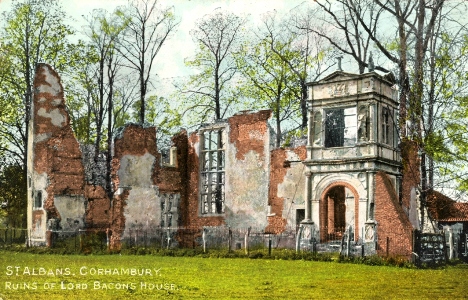
But the vast majority of primary resources are held at Hertford Record Office, as Grimston purchased the former home of Sir Francis Bacon, Gorhambury in St Albans, and so the records ended up being stored there. It's not too far away, but time and organisation is required so I have not yet been able to get there as often as I would like.


The ruins of Gorhambury that Sir Francis Bacon and Sir Harbottle Grimston would have lived in, the current residence having been built in the mid-eighteenth century.

So there I will leave it for now, just a brief insight into how I came to decide on the book I am writing. I will post a few articles over the next week or so, as it will help me to put thoughts and ideas out there, and any who has knowledge of material they believe will be useful, please feel free to share with me.