Sunday, 19 August 2012

Julian Assange's plea!

Julian Assange made his plea to the world today, and although in many ways many of us can sympathise with the words, his refusal to defend himself against the accusations against him, does not endear him to us. Anyway, watching the speech he made from the balcony of the Ecuadorian Embassy today reminded me a bit of Juliet, so here is my attempt at a pastiche.


Oh freedom, freedom! Wherefore art though freedom?
You have been denied me;
By that which was founded in that name, but be aware, I will not be crushed.
Even though thou art my enemy, and continue a witchhunt against me;
And thou does not act in the name freedom but as a watcher on the world.
But the world was watching too, and so the convention was maintained.
You hold a man who upholds that freedom, as Russia does those who ask for it,
Freedom is not just a word it is a concept, and I applaud the resolve and generosity of this support,
And so I say to the Americans, look to your past, re-affirm that spirit of freedom or you will
" lurch off the precipice, dragging us all into a dangerous and oppressive world in which journalists fall silent under the fear of prosecution and citizens must whisper in the dark."

(P.S. I do not claim to be a poet)

Saturday, 28 July 2012

An armchair view of the London Olympics 1

I have been looking forward to the London Olympics for seven years ever since we won them in 2005. The joy was marred the following day by the murder of 52 innocent people just going about their lives in London. I was pleased that this wasn't forgotten by Danny Boyle in his breathtaking opening ceremony last night.

Indeed, I'd go as far as to say it was my favourite moment, not only for the montage of the photos of the victims, but for the brilliant Akram Khan dance that went with it. The second, and truly spectacular moment, was when the iron workers created five metal rings, which then lifted up to create the Olympic rings, absolutely astonishing to watch.


I thoroughly enjoyed the rest of the ceremony too, which had many elements, and yes, was a bit jingoistic, but these things are events, they are huge one stop advertising campaigns for the host nation.

Opinions have been very divided, with many loving it, but just as many it seems hating it, for all sorts of reasons. Some feeling that its portrayal of British history was just too good, and missed out on the many bad things we had done over time.

Well yes, it would, as I said the opening ceremony is advertising pure and simple, and advertisers always exaggerate the good bits. Others have disliked it for its 'left wing' message, though if promoting things like women's suffrage and the NHS is a purely 'left wing' exercise that would upset a lot of Conservatives, with one or two making unwise comments, which they've then backtracked on.

Some just found it cheap and tacky, but I, and many I know were enthralled, across the spectrum, and treated it like an event. That's all I will say on the actual show, other than to say the final scenes when Sir Steve Redgrave brought the torch into the stadium, and handed it to seven young athletes who then went on to light the cauldron was a fitting end to the entire ceremony, and fits in with the legacy the games is all about.

So what of the first day's sporting trials and tribulations? Well to start with, it wasn't really the first day, as the men's and women's football tournaments had already kicked off, and yesterday two world records were broken in the men's team archery preliminaries. The British men scraped a 1-1 draw against Senegal, whilst the women have beaten New Zealand (1-0) and Cameroon (3-0) to secure a quarter-final place.

Today's big hope for British medals was in the men's road race, which following on from Bradley Wiggins' brilliant victory in the Tour de France, was expected to produce a gold medal for the world champion Mark Cavendish. Alas it wasn't to be Team GB's day, and a probable combination of tiredness (the Tour only finished last Sunday) and poor tactics meant they were never really in it, once the breakaway occurred.


Other than that, it has been a typically mixed day for the British competitors, with a few very good performances in the rowing, which contrasted with a number of early exits in events like the team archery, and men's and women's doubles in tennis, though an honourable mention here to Laura Robson and Heather Watson who ran a combination of Angelique kerber and Sabine Lisicki (Wimbledon singles semi-finalists in 2012 and 2011 respectively) very close.  We did have one victory on the courts with Elena Baltacha dispatching her Hungarian opponent with ease.

One of the advantages of hosting the games is the opportunity for British teams to compete in events they have previously failed to qualify for. Therefore today our women competed in handball, and men and women in the two forms of volleyball. This can only be good experience for the future, and hopefully will encourage children to take up these sports.

A number of medals have already been awarded, with Alexander Vinokourov beating a Colombian rider to that road race. Italy had a very good day, not only surprisingly beating the United States to the team archery gold, but collecting all three in the women's foil in fencing.

A world records was set winning gold in the pool with 16-year-old Yi Shiwen of China (who incidentally won the first gold of the games in shooting) won the 400m individual medley. Ryan Lochtie won the USA's first gold, but it looks like the chinese are already looking the country to beat outside of the track.


So I found it an absorbing first full day of competition, and look forward to the rest of the games. Naturally I hope to see a great deal of British success, but if we see good performances, few, or even better no disqualifications for drugs, and nobody gets seriously hurt, the games will be a success. New stars will emerge, and others will fade, but that is life as well as sport. I hope you will enjoy it as much as I intend to, and will give my second view in a couple of days.

Friday, 29 June 2012

Be this Cicero reborn?

Harbottle Grimston was the eldest surviving son of Sir Harbottle Grimston Bt of Bradfield Hall, Manningtree in Essex, near the town of Colchester. Grimston had been elected one of the MPs for Colchester in April 1640 in the parliament that ran until May 5th that year, and is known as the Short Parliament.

Charles I had dissolved parliament in 1629 and instigated what became known as personal rule, which he maintained until April 1640. During this period, as you can imagine, a lot of grievances built up and so when parliament was recalled, because Charles had run out of ways to raise money, parliament presented him with the Grand Remonstrance.

The reason Charles had recalled parliament was so he could be granted the funds to fight the Bishops War, which was an attempt by the Scottish church to resist the reform of its Presbyterianism system. Although Scotland was still nominally independent at this time, because Charles' father, James I, had also been King of Scotland (James VI) they shared a single monarch.

Therefore there was an inevitable clash between the desires of the King and parliament, and as agreement seemed impossible, Charles dissolved the House after only three weeks.

The title of this blog is inspired by a poem written in the 17th century and published in the Essex Review as part of an article on the Essex Petition of 1679-80. Entitled 'The Essex Ballad' it is a tale of Essex, and more specifically Colchester, with its references to oysters, the Dutch and bays. The second and third verses read:

The Squire, whose Name does famous grow
As Marcus Tullius Cicero
And keeps true time with Sir A________ _______ A___________

As freely gave himself his hand.
As once his Voice to rule the Land
By such as should not understand
Too rashly.

The author believes the squire mentioned to be Harbottle Grimston, who like Cicero had been a lawyer,  before he entered parliament. Marcus Tullius Cicero had been a Roman statesman noted for his oration, and also a rebel in his own way, so the allusion is perhaps doubly apt.


As a new MP in 1640 Grimston had a reputation to gain, and having taken the parliamentary side in the arguments regarding supply versus grievances, and like Cicero, he used his speaking skills to attack the organs of the state, particualarly the advisors to the King. The poem, if it is Grimston, probably refers to a speech made in 1679 protesting against an action of Charles II, but you'll have to read the book to find out about that, unless nobody wants to publish it of course.

Grimston had made a number of interventions since parliament's recall by Charles I, but his first really noted one came in 1641, when he spoke in a debate in which he accused the Archbishop of Canterbury of high treason.

Throughout the period of personal rule, Laud had been one of Charles' key advisers, and this, for puritans such as Grimston was a problem. One of their greatest grievances was a belief that Charles and Laud wanted to return England to Catholicism. Although untrue, what they they did like was ceremony and glamour, and their high church faith which included many Catholic element, which they believed was driven by arminianism.


But I am not intending to give a history of these arguments, they are stated in great detail elsewhere, and I will save my views on it all for the book. However, to Grimston these accusations put William Laud amongst the worst possible men. Some of Grimston's ire may well have been driven by his father suffering imprisonment for refusing to pay ship money (a tax Charles used to raise funds during his personal rule), but as we look at the speech, we can perhaps see where his reputation came from?

The previous day, a House committee had agreed to sequester the Archbishop, but as Grimston began he wished to, "offer my reasons, why I concieve it more necessary we should proceed a little further than the desire of bare sequestration only."

But early into his speech, Harbottle Grimston tells us exactly what he thinks of Archbishop Laud:

We are now fallen upon the great man, the Archbishop of Canterbury; look upon him as he is in highness, and he is the sty of all pestilential filth, that hath infested the state and government of this commonwealth. Look upon him in his dependencies, and he is the only man, the only man who hath raised and advanced, that together with himself, have been the authors and causers of all our ruins, miseries and calamities we now groan under.


The members sitting in the chamber can have had no doubt what Grimton's intentions were, and as he followed this with an excoriating attack on those that Laud had promoted to positions of prominence, the 'popish bishops.'

The men advanced were not, of course, Catholic, but to puritans such as Grimston (Pym, Prynne, Hampden and others you will hear of in the book) their love of splendour and ritual meant they were not followers of the true faith.

He accuses them of 'devouring the flock' when they should have fed them, although this includes a convenient amnesia regarding the actions of Henry VIII and Edward VI when he said:

It was the happiness of our church, when the zeal of God's house eat up the bishops, glorious and brave martyrs, that went to the stake in the defence of the protestant religion, but the zeal of the bishops hath only been to persecute and eat up the church.

To the puritans, this percieved attack on the church was the most important of their battles. Although there were many other grievances that had been stated in the Grand Remonstrance, it was this that was galvanising them into action.

However, Grimston cleverly extends the insidious reach of Laud into trade, particularly that of tobacco, and how it was affecting the day to day lives of those employed in the trade, and was causing people to lose livelihoods they'd been in since apprentices. Grimston is accusing Laud of spending more of his time raking in money from this trade, rather than in the pulpit.

There were few rules guiding 'unparliamentary' language in those days (indeed it was actually illegal to record debates, but many did by various methods), and so Grimston's attack on Laud became even more vociferous. He gets into his stride as he expounds:

Mr Speaker, we know what he hath been charged withal in this House, crimes of a dangerous consequence, and of a transcendent nature, no less than the subversion of the government of this kingdom, and the alteration of the protestant religion.

The assault is relantless as Grimston says that there is 'clear and manifest proof' that Laud's hand is present in every complaint and grievance, and he was like a buzzing and angry wasp, "his sting is in the tail of everything."

After this build up, there was only one place Grimston had left to go:

Mr Speaker, he hath been the great and common enemy of all goodness, and good men, and it is not safe that he should be near His Majesty's person, to distil his poison into his sacred ears, nor is it fit for the commonwealth that he fit in so eminent a place in government, being thus accused....This man is a corrupt fountain, that hath corrupted all the streams, and until the fountain be purged, we can never expect, nor hope to have clear channels.

Then comes the killer blow:


I concieve it is most necessary and fit that we should take up a resolution to do somewhat, to strike while the iron is hot, and to go up to the Lords...and accuse him of high treason..

The Archbishop of Canterbury was indeed subsequently imprisoned in the Tower, and eventually executed in 1645. Although there were other speeches that day in support of Grimston's motion, his was almost certainly the clinching argument.


At the opening of this blog, I posted a couple of verses from a poem, in which a man, believed by the author to be Grimston, was compared to Cicero because of his oratorical skills.Whilst having read many Harbottle Grimston speeches during my research, and agreeing he was a good speaker capable of making points in a powerful way, he lacked the rhetorical flourishes that resound down the ages:

Six mistakes mankind keeps making century after century:
Believing that personal gain is made by crushing others;
Worrying about things that cannot be changed or corrected;
Insisting that a thing is impossible because we cannot accomplish it;
Refusing to set aside trivial preferences;
Neglecting development and refinement of the mind;
Attempting to compel others to believe and live as we do.
 

“For books are more than books, they are the life, the very heart and core of ages past, the reason why men worked and died, the essence and quintessence of their lives.” 

“What is morally wrong can never be advantageous, even when it enables you to make some gain that you believe to be to your advantage. The mere act of believing that some wrongful course of action constitutes an advantage is pernicious.” 

So I think we can say the anonymous author of the poem was using poetic licence in comparing Harbottle Grimston to Marcus Tullius Cicero, what he did do, was draw attention to a man whose rhetoric made a great impact in his time.


With this speech Grimston cemented his place amongst the leading lights of the Parliamentary Party, and he was placed on many of the House's most important committees, including chairing some of them. The next taster will deal with the commission which was sent to the Isle of Wight to try and negotiate with Charles, and end the first war, of which Grimston was a member.


Friday, 15 June 2012

797 years ago today.......


The 15th of June is a big day in history, the United States Constitution was ratified, the Rosenbergs were executed, and Jaws was first released. Okay the last isn't important in the great scheme of things, but for a certain generation it is, because it's an iconic film of its time.

But for the British, or to be more accurate the English it is probably one of the top ten dates in history, and ranks alongside The Battle of Hastings, Agincourt and Bosworth. However, unlike these three examples, it isn't a battle we celebrate, but the signing of a piece of parchment.

On this day in 1215, King John met with a number of barons, and was forced to sign the Magna Carta (or great charter), a document that is one of the most famous in English history. It is important not only as a historical event, but because it compelled the King to concede that his power was not arbitrary, though James I and his son Charles I were believers in the 'divine right of Kings.'


As a document seeking to restrict a monarch's powers, the charter was not unique as Henry I had agreed the Charter of Liberties in 1100 which limited his powers in certain areas. But the Magna Carta is one of the most recognisable names in our island's history.

If you take the time to trawl through it, you'll recognise many things that we take for granted today, but it is also very much a document of its time, as it deals principally with issues relating to the barons, and has political interests such as in clause 50 (clauses were created at a later date):

We will remove completely from their offices the kinsmen of Gerard de Athée, and in future they shall hold no offices in England. The people in question are Engelard de Cigogné', Peter, Guy, and Andrew de Chanceaux, Guy de Cigogné, Geoffrey de Martigny and his brothers, Philip Marc and his brothers, with Geoffrey his nephew, and all their followers. 

de Athée being a mercenary who had served John in France, and had cost a thousand marks to free after he had been captured. He had then been rewarded with grants of estates to family members, and many influential and financially beneficial offices.


There are also many clauses relating to marriage and property rights, so it could easily be thought the barons are only concerned about their own. But clauses such as 38 which states, " In future no official shall place a man on trial upon his own unsupported statement, without producing credible witnesses to the truth of it," indicate that an attempt, within the thinking of the time, was made to be inclusive.

Measures were to be standardised for ale, wine and corn, and there were a fair number of clauses to protect free men (a man not tied to a lord or manor) from arbitrary rule. These were all very important and sought to bring order in the life of the kingdom. In fact there also clauses which protected women's rights to property and dowries (if very restricted but then this was the 13th century) but 54 is most indicative of women's place in medieval society, " No one shall be arrested or imprisoned on the appeal of a woman for the death of any person except her husband."

However, certain elements have become especially famous clause 40 stating that, "To no one will we sell, to no one deny or delay right or justice." Number 39 is perhaps the most recognisable to modern sensibilities:

No free man shall be seized or imprisoned, or stripped of his rights or possessions, or outlawed or exiled, or deprived of his standing in any other way, nor will we proceed with force against him, or send others to do so, except by the lawful judgement of his equals or by the law of the land. 

Indeed it could be argued that our modern governments might do well to revisit some of these clauses, as in the 'interests of security' authoritarianism is in danger of becoming the mantra.

In effect in can be argued that the Magna Carta is the nearest to a written constitution that this nation of ours has ever got. The protection of property and the protection of freedoms, in the context of the time, was a very radical action, even if its primary purpose was to protect barons from the arbitrary actions of a distrusted and despised King.

The principal clause which deals with this issue is 61, which establishes a committee of 25 barons which could meet at any time in order to over rule King John if he broke the charter, and even seize castles and possessions. It could be argued that the barons were seeking to overthrow the monarch, and although this is possible, the idea of any other system other than monarchy was not on the table. John's son Henry would have been the heir, and as he was only eight in 1215, they would have had the opportunity to mould him to their way of thinking.

But John did not do much to try and dispel this reputation as a despot, as once the barons had left London he repudiated and the pope Innocent III (John had previously been excommunicated by a pope but that's another story) annulled it declaring it a, " "shameful and demeaning agreement, forced upon the King by violence and fear."

Almost inevitably war followed as the First Barons' War  followed, which ended in 1217, whereas John had actually died the previous year (dysentery being the most commonly accepted cause). John's son Henry III succeeded him, and he had his own problems with barons in future years.

Magna Carta is considered one of the foundations of English and British constitutional law, and was a real break from the past in many ways. A document protecting certain freedoms and rights, although not unknown, was unusual before the modern period. But Henry I's has established where the monarch could encroach on the rights of nobles, whereas Magna Carta had dealt with the relationships of subjects with each other, and provided legal protections.

I think it is one of the great documents of British history, and that it rightly takes its place amongst those much revered. Reading through it we can see the roots of many of the rights and privileges we enjoy today, and in often take for granted, forgetting just how hard they had to be fought for, and the many that died doing so.

But it was also a document of its time as the barons sought to protect themselves from the King's arbitrary wielding of power, although there are those that argue John has had an unreasonably bad press. But as a young man he rebelled against his father Henry II, and although put in a rather invidious position by his brother's kidnap, his myriad personality faults, and his lack of social skills added up to an unhappy period for the English during his reign.

This was only a short blog, and not a history lesson, so for those interested in learning more In Our Time  had a very interesting debate on the Magna Carta, and there are a number of revisionist articles standing up for John, most notably Graham Seel's in February's History Today.


Sunday, 3 June 2012

Writing history; Or how I got the idea to write a biography

A few years ago I thought I'd try and write a history book, but the issue became what to do it on. Perhaps I was approaching it backwards in deciding to write the book, then find the subject, instead of the other way round. However, seeing as our MPs usually wait to see if they get drawn in the private member's ballot before selecting a bill, I am following precedent.

I did my degree, many years ago, in history and politics, so thought the I'd try and combine the two, and with Colchester having such a rich past, I decided that a bit of local history would fit the bill.  With my Latin and ancient British languages being non-existent, I decided to eschew the Roman era, and go for something much more recent.

Now for those of us who consider ourselves historians, modern does not mean now, or even within the last fifty years or so, but can include what many consider, a long time ago. When I did my original degree at Essex University, they considered the 'early modern period' to have started in 1485, at the beginning of the Tudor era (which I will still use despite Clifford Davies's protestations) and finally ends around 1750, the beginning of industrialisation in Britain.

Seeing as I was going local, I thought okay, now Colchester actually played a part in what are called  the English Civil Wars, or even as 'The Wars of the Three Kingdoms' seeing as Ireland and Scotland became heavily involved.

Colchester's most famous contribution is the siege, which lasted from 12 June-28 August 1648, when a troop of Royalist soldiers managed to barricade themselves inside the town walls, and Parliamentary troops led by Sir Thomas Fairfax blockaded the town. Eventually, after much privation the Royalist troops surrendered, and two of their commanders, Sir Charles Lucas and Sir George Lisle, were summarily executed behind the castle. My picture for this blog was taken next to the monument raised in 1892.

However, the siege has featured prominently in the myriad books about the wars, and for my first effort I wanted to do something I thought might be easier. I therefore decided to start trawling through Colchester's MPs, and the idea of writing short biographies of each appealed. I hadn't seen anything like that around, and thought it would be a good, and concise way of bringing together history and politics.

As I looked through, just drawing together a list, thinking perhaps selecting a number at specific points might be the way to go, I chanced upon the name of Sir Harbottle Grimston. Now this is a name to make anyone stop and look further into, so I did.

The more I delved, the more interesting he became. He was one of Colchester's MPs during the period of the conflicts, but had also ended up spending time in the Tower of London, and was actually the Speaker of the House of Commons which welcomed Charles II to England in 1660. He topped this off with becoming  Master of the Rolls before dying in either 1685 or 1683 (depending on what you are reading) in St. Albans, and is buried alongside Sir Francis Bacon.

'So?' I asked myself, if this man did so much, why haven't I heard of him? I don't pretend to be an expert on the period, but you would think with having such an accomplished son, Colchester would have at least one monument of some sort, even if it was restricted to a blue plaque somewhere? But htere is absolutely nothing, bar a portrait in the Town Hall.


The portrait above of Sir Harbottle is by an unknown artist, but probably based upon a portrait by Sir Peter Lely. He is in the robes of the Master of the Rolls according to one source, although the National Portrait Gallery seems to think they are Speaker's.

As I began my researches, one thing I quickly discovered I had to be careful about was which Harbottle I was talking about. Father and son shared the same name, and were both Members of Parliament during the period from 1640 (when Charles I's personal rule ended) until 1647 when the first baronet died.

It was fairly simple to tell the difference in most documents and books where they are mentioned, because the first baronet is the one with the title. This could have been a lot trickier, if young Harbottle had been awarded the knighthood  the eldest sons of baronets were normally awarded, but as he was in  fact a second son, his elder brother having died, he possibly wasn't actually entitled to it.

These are the sort of questions I knew I would need to try and find answers to as I researched my biography, for by now I was so intrigued by this man, that I decided I might as well follow it through. After all, if there seems to be almost no trace of him in the town where he first appeared on the national scene, I thought there was an opportunity for something original.

I do not intend to go into too much detail about what I've discovered to date, and will save for specific blogs, and hopefully for the book, if it is ever published. But a few titbits that will hopefully interest you, and want you wanting to know more.

He first seems to have come to the notice of many outside parliament, when in a speech against Archbishop William Laud, he called him, " 'the sty of all pestilential filth that hath infested the state and government of this commonwealth,'' although this doesn't seem as original an insult as I believed for a long time, as Nehemiah Wallington used it, and it appears it may have been a puritan comment regarding those believed to be engaged in lustful activity, but more of that on another occasion.

Grimston appears now and again in books on the period, usually in reference to this speech, or in his role as Speaker during the Restoration. However, one historian who features him more extensively is John Adamson in his excellent 'The Noble Revolt' who also believes (as I have come to) that he is more significant than generally believed.

I have read one comment which describes Grimston as, 'almost a great man,' so my basis question I've asked myself is, Is Sir Harbottle Grimston deserving of greater recognition than he has hitherto received?

I thought that a good place to start, and I feel it enables me to view the materials with a dispassionate eye, as I always have that question in the back of my mind.

In Essex we have a superb records office, which holds quite a bit of material relating to the period, and some original letters to and from Grimston, and I am gradually wading through those, though I am having to practise reading seventeenth century handwriting, which is a bit of a job.

But the vast majority of primary resources are held at Hertford Record Office, as Grimston purchased the former home of Sir Francis Bacon, Gorhambury in St Albans, and so the records ended up being stored there. It's not too far away, but time and organisation is required so I have not yet been able to get there as often as I would like.


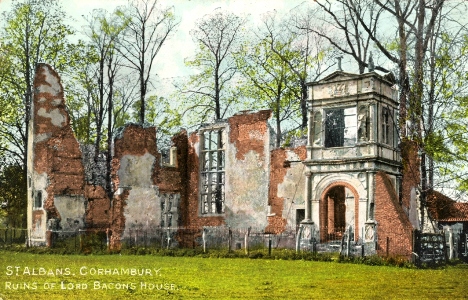
The ruins of Gorhambury that Sir Francis Bacon and Sir Harbottle Grimston would have lived in, the current residence having been built in the mid-eighteenth century.

So there I will leave it for now, just a brief insight into how I came to decide on the book I am writing. I will post a few articles over the next week or so, as it will help me to put thoughts and ideas out there, and any who has knowledge of material they believe will be useful, please feel free to share with me.


Friday, 16 March 2012

Some lessons are never learned....

I received a phone call this morning from someone I know very concerned. They had received a loan agreement from a high street bank, and it was just awaiting signature and return.

So I popped round, and looked at the agreement, which was badly printed, and had an offshore number as part of the address. This looked very strange,and when we tried to contact the freephone number it was unavailable.

Therefore, we rang the office of the bank my friend has an account with. After much tooing and froing, and misunderstandings, we finally got hold of the correct department. The matter was quickly cleared up, and what had happened was that because my friend had kept up to date with the payments on a previous loan, which is nearing its end, they just sent out a new one. My friend was advised to just throw it away and think nothing more of it. Of course, the bank could have avoided this problem by just including a covering letter explaining what this was all about, but it seems they have been taking lessons in communication from Andrew Lansley.

As you can imagine, this was all a relief, but it does demonstrate a much wider problem. We have been going through a severe financial crisis over the last few years, brought on by the behaviour of banks and other financial organisations, arguably the behaviour of governments, and the excessive debt levels of the man in the street. As Barack Obama repeated often during his 2008 election campaign, Wall Street gets a lot of the blame, but Main Street has played its role too.

Credit became easy to get, not only from banks but from other sources, and the so-called 'sub-prime' mortgages were a timebomb waiting to explode. I won't go over the ins and outs of the crisis, as they have been explored ad infinitum, and will be debated for years to come.

My point is that despite everything that has happened, and the economic and political consequences the banks do not seem to have learned their lesson. We have had a lot of discussion in recent months over banker's bonuses, and how those at the top often seem more concerned about their own pay packets.

But as I have already alluded to, access to easy credit, and the huge amounts of personal debt, have also been prime contributors to the problems we are now enduring. So why are banks not only offering unsolicited loans to account holders, but with the base rate at 0.5% (which has been in place for some three years now, and not just since the coalition came in, despite what David Cameron says) but have APR's of 19.1%?

Unfortunately not everyone is in the position of my friend, who is determined not to acquire more debts, but so many out there may feel they have no option but to take these on. Therefore, we are in severe danger of just going round in circles, and building up billions in personal debt all over again.

Incidentally, government's don't seem to learn particularly well either, as Labour's quantitative easing had nowhere near the stimulating effect it should have, and the coalition are just pumping more in. The banks just sit on it and boost their reserves, instead of lending it to businesses so they can expand and create jobs.

So the same set of circumstances that caused the initial crisis are in danger of being repeated, as banks attempt to tempt customers with easy credit at high rates of interest, and the government offers 95% mortgages. Hopefully this will spur the home buying market back into action, but it could also be storing up more problems down the line.

As ABBA so wisely sang in 1973, 'The history book on the shelf, is always repeating itself...,' and if banks especially don't do something to change their behaviour, then we could all be heading for a second financial Waterloo.

Wednesday, 14 March 2012

Respecting the public's views - An MP replies on the Health and Social Care Bill

Like many ordinary people over the last few weeks and months, I have been doing my bit to try and halt the Health and Social Care Bill, which is now on its final stages through the House of Lords before gaining royal assent.

Last week the government lost an appeal against an ruling from the Information Commissioner that they should publish the Transitional Risk Register. In yesterday's debate on the 'drop the bill' epetition, Andrew Lansley said he wouldn't be doing so until the tribunal published its reasons. I expect that once that happens, he will then appeal to the High Court, and during the ensuing delay, the bill will become law.

With this in mind, Lord Owen, a former GP, and Labour Foreign Secretary in the Callaghan government, has tabled an amendment for debate next Monday asking that the bill be paused, until the Risk Register has been published, so all aspects can be properly considered. This amendment will almost certainly be defeated, unless a number of Liberal Democrat peers, and a large proportion of the cross-benchers support it. Hopefully sufficient consciences will be pricked to support it.

This all goes against David Cameron's recent pronouncements that his government will be known for its transparency, though recent rumours that the government is seeking to amend the Freedom of Information Act, and perhaps start charging for it, doesn't inspire much confidence.

Anyway, this debate has been much discussed, and will be over the years, as the HSC Act begins to affect the way health services are provided in England (Wales, Scotland and Northern Ireland run their own affairs.

What I intend to just mention today is the way many MPs have responded to this campaign. In that vein, I would like to pay tribute to the many who have tried to engage properly with correspondents, and not just tried to fob them off because they aren't constituents.

I wrote principly to Liberal Democrat MPs, and recieved many courteous replies, explaining their positions and dilemmas, particularly Stephen Gilbert, Charles Kennedy and Tim Farron. I will also mention is despatches Nick de Bois who was happy to correspond via twitter.

I beleive this shows MPs at their best, willing to engage with the public over issues, and not pretending they are just there to be told what to do. I know many of my colleagues who also campaigned can speak of similar experiences. So below I will post the reply I recieved from Tim Farron, as I made a last ditch attempt at persuasion this week.

I do not agree with much of what Tim says, but he deserves great respect fro taking the time to reply properly, to me and no doubt many other correspondents. This is in marked contrast to my own Conservative MP Priti Patel, who I wrote to a number of weeks ago, and did not even deign to acknowlege my email. That is until I complained and copied the mail to the cheif whip, when I recieved a rather snippy reply from an adviser. To date that is the only reply I have had.

So, again I pay tribute to those MPs from all parties who took the time, and had the courtesy to reply to all correspondents, despite having been deluged over recent weeks. This is Tim's reply:

Dear Mr Hough,
Thank you very much for your message on the Government’s NHS Bill. I am aware that in your correspondence you raised some specific concerns. As you can understand, I have been inundated with correspondence on this matter and therefore it would take a huge amount of time for me to respond to each and every point, but thought it might be useful to outline my position on this Bill here.

I share your deep concern about this Bill. You may know that I did not vote with the Government on this Bill when it was last in the House of Commons. I was a critic of Labour’s competition reforms when they were in power and I am equally critical of these reforms.

When I am in Parliament, my approach is to try and make a difference, and so if I disagree with a Bill I will try to stop it, but I will also be pragmatic and do everything within my power, using amendments and parliamentary procedure, to make such a Bill better – that’s what I did when my party was in opposition and it is what I do now. That has been my approach on the Health and Social Care Bill. I don’t like the Bill, but I have also worked very hard to amend it beyond all recognition. This is not Andrew Lansley’s Bill of 14 months ago, yet almost all of the complaints I receive are from people who do not see how vastly different it is now.

The NHS is financially unsustainable in its present form because the increase in life expectancy and in the cost of medical treatments means that either the NHS drives down costs and is more efficient or else we will end up in the horrific situation of rationing. But whilst reform of the NHS is clearly vital, this Bill obviously has not secured the confidence of the British people or of the medical professions. For those reasons I will continue to vote for amendments to improve the Bill but I will not vote to endorse it.

Having said all of that, I hope you will take my word – without spin or partisan presentation - that this Bill is almost infinitely better than it was 14 months ago when it was first introduced (if that wasn’t true, I really wouldn’t insult you by trying to pull the wool over your eyes). A staggering one hundred and forty amendments were made to this Bill, mostly submitted by Liberal Democrats with some support from Labour and Conservative backbenchers. Whatever you think of the Bill, it would be unfair to ignore the impact that these amendments have made – especially when it comes to undoing the privatisation that Labour did to our NHS via the NHS Act 2006 and blocking the privatisation that the Conservatives have been pressing to include in the Bill.

It is also important to remember that the Bill contains important elements that protect the NHS from the effects of Labour’s privatisations. The 2006 Labour NHS Act let competition out of the bag – competition on price and not quality. For instance, my local hospital has a private surgical unit and we have a privatised out of hours GP unit all as a result of Labour reforms. This Bill contains new regulations to prevent private providers getting the advantages they were given by Labour. So, politically, it’s really tempting to want to ‘kill the Bill’, but anyone who wants to prevent US style competition should want those parts of the competition chapter of the Bill passed.

Here is a short list of some of the critical changes we have made to this Bill:

· reigned in the Tory’s instinct for competition without control by demanding that any competition is entirely based on quality and not price. Patients will be able to choose which care they receive, but this choice will be driven by quality and not by how much it costs to provide it. This contrasts sharply with Labour’s reforms which emphasised competition on the basis of price and which saw private providers being given a 14% premium over NHS providers.

· realigned the purpose of the health regulator Monitor so that it promotes the interests of patients, and not competition, as an end in itself – again, a huge step forward from the competition-focus that Labour left us with and which Mr Lansley wanted. Without this change, there was a real danger that Monitor could end up defending the interests of providers over patients. Thankfully, this danger has been averted.

· made sure that there are much clearer lines of accountability to local authorities and communities, so that clinical experts making the decisions about which health services to provide locally will have to be open about how and why they make their decisions. Some senior clinicians base their opposition to the Bill on their concern that these new lines of accountability will make it too hard for them to close hospitals – something I haven’t heard Labour talk about in public!

· insisted that Foundation Trusts have to demonstrate how the money raised from private income is being used to improve services for NHS patients as part of their annual report. At the moment, thanks to Labour reforms, private income can be solely pocketed by shareholders.

· established a stronger, clearer line of accountability of the NHS to the Secretary of State and to Parliament.

· changed GP commissioning groups Clinical Commissioning Groups, which means that other clinical professions e.g. nurses, pharmacists, physios etc. must be on the group.

· require the Secretary of State, NHS Commissioning Board and CCGs to not only tackle health inequalities, but also to report annually on their progress towards this goal.

· ensure the Secretary of State has a duty to secure comprehensive health care for the whole population and ensure that Clinical Commissioning Groups (CCGs) fulfil this duty.

· require each provider of healthcare services to co-operate with other providers of health and social care services.

· make it clear that the health regulator Monitor has the power to require healthcare providers to promote integration of NHS services.

· make sure patients have a greater say in their health, with the NHS Commissioning Board and CCGs having stronger duties to promote patient involvement in their own care.


I will keep fighting to protect our NHS and to keep it public.

Best wishes,

Tim Farron